
Inkjet Printing Moves from Disruption to Dominance

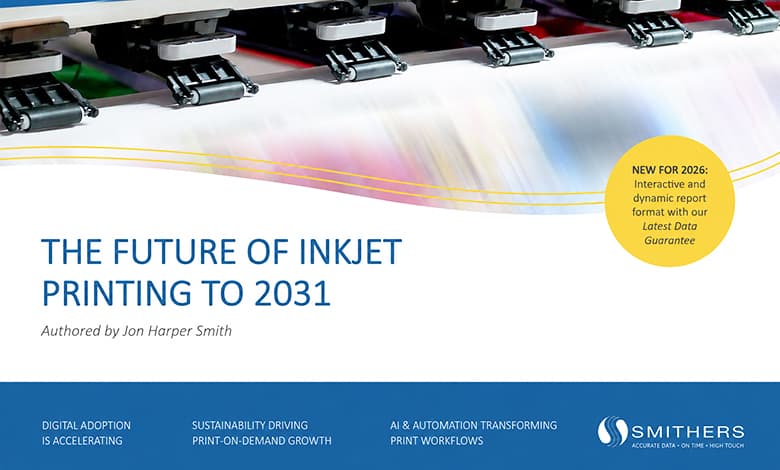
Inkjet printing is entering a new phase of global growth, moving beyond its earlier role as a flexible alternative to analogue print and becoming one of the most important production technologies across graphics, packaging, publishing, textiles, and industrial applications. According to Smithers’ latest report, The Future of Inkjet Printing to 2031, the global inkjet market is expanding strongly across both graphics and packaging, as well as industrial and functional print sectors. The report forecasts graphics and packaging inkjet output to reach $134.6 billion by 2031, while industrial and functional inkjet is expected to reach $42.7 billion.
Packaging Becomes a Major Growth Engine
One of the strongest drivers of this transition is packaging. While commercial print and transactional print face pressure from digital communication, packaging continues to grow because it is closely tied to consumer goods, retail, logistics, food, pharmaceuticals, and e-commerce. Labels, corrugated packaging, flexible packaging, folding cartons, and direct-to-shape decoration are all areas where inkjet is gaining attention.
For brand owners, inkjet offers clear advantages. It allows faster product launches, smaller batch sizes, regional campaign variations, seasonal packaging, and reduced inventory risk. Instead of producing large volumes of pre-printed packaging that may become obsolete, companies can print closer to demand. This supports leaner supply chains and reduces waste.
Asia Pacific Leads the Expansion
Asia Pacific is emerging as the most important region in this transformation. Smithers notes that Asia is both the largest and fastest-growing region for inkjet, with China and India playing major roles as consumer markets, manufacturing hubs, and increasingly important producers of inkjet hardware and consumables.
This has strategic implications for the global printing equipment market. Western manufacturers remain influential, but Asian suppliers are becoming more competitive, especially as local manufacturing capabilities improve and demand grows across packaging, textiles, signage, and industrial print.
Technology Becomes More Application-Specific
The technology itself is also changing. Earlier inkjet systems were often general-purpose machines designed to serve multiple applications. Today, the market is moving toward highly specialised, application-optimised presses.
Equipment manufacturers are developing machines for narrow-web labels, corrugated packaging, book printing, textile decoration, wide-format graphics, ceramics, décor, electronics, and other industrial uses. This reflects a more mature market where customers expect productivity, reliability, automation, and lower total cost of ownership — not simply digital capability.
Ink Chemistry and Sustainability Take Centre Stage
Ink chemistry is another major area of change. Sustainability concerns, food safety regulations, recyclability targets, and lower emissions requirements are reshaping the ink market. Water-based inks are gaining ground across multiple segments, including textiles, corrugated, commercial print, books, and packaging.
This is particularly relevant for packaging, where migration, food-contact compliance, odour, recyclability, and safe handling are critical issues. Solvent-based systems still have a role in certain applications, but brand owners and regulators are pushing the industry toward cleaner alternatives.
Automation and AI Improve Inkjet Economics
Automation and artificial intelligence are also changing the economics of inkjet. Historically, analogue technologies such as offset, flexo, and gravure held a cost advantage in long-run production. Inkjet had strong flexibility, but higher ink costs and machine investment often limited its competitiveness.
That gap is narrowing. AI-driven diagnostics, predictive maintenance, inline inspection, automated colour control, job scheduling, and fleet management software are helping improve uptime, reduce waste, and lower operating costs. For print service providers, future competitiveness will depend not only on owning digital presses, but on running them intelligently.
Opportunities for the Middle East
The implications for the Middle East are significant. The region has a growing packaging sector, expanding retail and e-commerce markets, strong demand for labels, and increasing investment in food, pharmaceutical, cosmetics, and industrial manufacturing.
These sectors require faster turnaround, smaller batches, multilingual packaging, regional compliance, and brand differentiation. Inkjet can help converters respond to these needs while reducing dependency on long production cycles and excessive inventories.
Inkjet Becomes a Core Production Platform
The future of inkjet will not replace every analogue process. Offset, flexo, gravure, and screen printing will continue to play important roles, especially where very long runs, special effects, or specific substrate requirements dominate. However, the balance is changing.
Inkjet is becoming more productive, more reliable, more sustainable, and more economically attractive. By 2031, it will be deeply embedded across the global print value chain, supporting smarter packaging, faster publishing, more agile manufacturing, personalised communication, and cleaner production models.
For printers, converters, brand owners, equipment suppliers, and investors, the message is clear: inkjet is no longer a niche technology or a future promise. It is becoming one of the central engines of growth in the modern printing industry.