
Print’s Next Growth Move
Why flexibility, smarter capacity and sustainable production will define the Middle East’s next print growth cycle.


POWER TO MOVE | FEATURE SERIES — ARTICLE 1 OF 4
By Shadi Bakhour – B2B Business Unit Director, Canon Middle East
The investment question has changed
For many years, investment decisions in professional print were framed principally around capacity: how many sheets, pages or square metres could be produced in a shift. Capacity still matters, but it is no longer a sufficient measure of competitiveness. The more strategic question today is: what range of profitable work will this production environment allow the business to accept tomorrow?
That distinction is becoming increasingly important across the Middle East, where investment decisions are under greater scrutiny, customer expectations continue to evolve, and margins can no longer be protected by volume alone. The next cycle of growth will favor businesses that align technology more closely with demand while expanding application opportunities without adding unnecessary operational complexity.
This is the thinking behind Canon’s Power to Move platform. It is not simply a statement about faster technology. It reflects a wider belief that print has the power to move businesses forward when innovation is connected to real applications, informed investment and measurable customer value. Technology should not be introduced for its own sake; it should help a print provider become more capable, more resilient and more relevant to the markets it serves.

“The decision is no longer simply which machine to purchase.
It is which business capability to build.”
Four forces reshaping professional print
The first force is the continued shift towards shorter, more frequent and more targeted production. Offset remains highly effective for the right volumes and applications, and the industry should avoid simplistic predictions about its disappearance. What is changing is the crossover point. More jobs now require a combination of shorter setup, rapid turnaround, versioning and reduced inventory, making digital production increasingly practical alongside established analogue capacity.
The second force is application proliferation. Customers are no longer buying print volume in isolation. They may require a short-run book, regionally versioned marketing material, personalised packaging, retail graphics, point-of-sale displays or seasonal campaign assets—often within one brief and on a compressed timeline. For the print service provider, the commercial opportunity lies in serving a greater share of that requirement rather than competing only for one element of it.
The third force is the pressure on utilisation and margin. A highly productive press does not automatically create a profitable operation. Setup time, makeready, waste, labour, job changeovers, reprints, workflow, finishing and asset utilisation all influence the true cost of production. The strongest investment case is therefore not always the system with the highest theoretical output, but the one that fits the company’s actual job mix and enables it to accept more valuable work with fewer production compromises.
The fourth force is sustainability becoming operational. Environmental responsibility can no longer sit only in a corporate statement. Customers and procurement teams increasingly examine energy use, waste, substrate choice, recycling and de-inkability, ink chemistry, unnecessary inventory and the impact of transport and supply chains. Sustainable production begins with producing the right quantity, on the right platform, with the right material and workflow for the intended life of the application.
From a machine portfolio to a business capability portfolio
One business may require a practical transition from toner into production inkjet. Another may need a B2 digital platform to complement offset and expand into premium commercial or paper-based packaging applications. A large-format provider may instead focus on consolidating flexible and rigid production. Different businesses require different pathways—but the objective remains the same: building new capabilities rather than simply replacing equipment.
Seen in this way, the decision is not simply which machine to purchase. It is which business capability to build. Can the investment help the company enter an adjacent application? Can it improve turnaround on work that is currently difficult to schedule? Can it reduce waste, simplify production or enable the sales team to offer a more complete solution? Most importantly, can it create a realistic path to new revenue?
Three production gaps—and three different growth paths
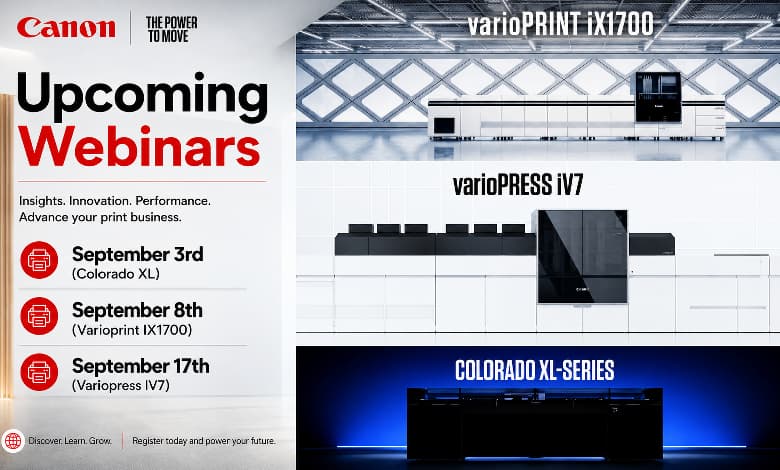
Canon’s latest additions to its professional print portfolio respond to three distinct production gaps. The varioPRINT iX1700 addresses businesses whose colour volumes are moving beyond toner, but which do not yet require the capacity profile of the highest-volume sheetfed inkjet platforms. The varioPRESS iV7 addresses the analogue-to-digital opportunity in B2 commercial production, where shorter runs, versioning, faster turnaround and selected packaging applications are changing the economics of work traditionally produced on offset. The Colorado XL-series responds to a different market entirely: sign, display, retail and décor businesses seeking greater flexibility across roll-fed and rigid applications.
These technologies should not be placed in one product box, because the customers, applications and investment questions are different. What connects them is the underlying strategy: filling a defined market gap and giving print businesses a more appropriate route to expand. Over the next three articles in this series, we will examine each of these areas in greater depth—not as product specifications, but as business decisions facing the industry.
Education must accompany innovation
As production technologies become more capable, investment decisions also become more complex. A specification sheet can indicate speed, format and substrate range, but it cannot determine whether a platform is right for a particular operation. Customers and partners increasingly need to understand workflow integration, application fit, finishing, production economics and return on investment—not simply product specifications.
For this reason, education is an important part of Power to Move. Canon is creating a series of live, technology-led webinars for Middle East customers and partners, connecting regional market needs with live demonstrations and specialist expertise from Canon’s Customer Experience Centre in Venlo. The objective is to move beyond a conventional product presentation: participants will be able to see the technology operating, explore relevant applications, ask technical and commercial questions and consider how each platform may fit within their own production environment.
WEBINAR REGISTRATION : Power To Move: Production Print Innovation – Canon Middle East
The webinars are only one stage of a wider process. Physical print samples, application and return-on-investment discussions, structured follow-up with account managers and, where appropriate, further technical validation can help turn interest into an informed investment decision. This digital-to-physical approach is especially valuable in a region where customers need credible proof before committing capital.
Growth through better alignment
The professional print industry does not need technology for technology’s sake. It needs production environments that are aligned with real demand and capable of evolving with it. For print businesses, that means looking beyond headline speed and asking harder questions about application breadth, workflow, utilisation, sustainability and the revenue that an investment can realistically unlock.
The strongest print businesses of the next decade may not be those with the largest collection of presses. They may be those that align technology most intelligently with the work their customers will need next—and use that capability to become a more valuable partner to those customers.
That is the purpose of Power to Move: to connect innovation with understanding, understanding with application, and application with sustainable business growth. In the next article, we will examine the missing step between toner and high-volume production inkjet, and why right-sized capacity may be one of the industry’s most important investment considerations.
Series note: This is the first of four Power to Move thought-leadership features. The following articles will examine the varioPRINT iX1700, varioPRESS iV7 and Colorado XL-series through the business and application opportunities each technology addresses.