
Printing Pioneer Frank Romano Celebrates Double Milestone


Printing legend Frank Romano reached a monumental double milestone in June, celebrating his 85th birthday alongside the release of his 85th book, a 500-page historical tome, titled History of the Typesetting Service. The achievement was honoured across the publishing and print industries by highlighting his successful career.
Lifetime of Industry Contribution
While industry circles often affectionately refer to him as the “Godfather of Print”, his remarkable career spans over six decades of profound influence on graphic arts. As an educator at the Rochester Institute of Technology (RIT), he mentored generations of industry leaders, bridging the gap between traditional typesetting and modern digital workflows. Romano has authored an impressive list of books and hundreds of articles, establishing himself as the definitive voice on digital printing, desktop publishing, and typographic history. His analytical insights accurately predicted major industry shifts, making him an indispensable advisor to global printing manufacturers and practitioners alike.
Famous Works & Historical Artifacts
Founder of eight publications, Romano’s extensive bibliography now forms the foundational curriculum for the graphic art and print industries. His most notable contributions include the Encyclopedia of Graphic Communications, a massive and definitive 10,000-term volume co-authored with Richard Romano. He also spent 35 years editing Pocket Pal: A Graphic Arts Production Handbook, an industry-standard manual.
His historical overviews, History of Desktop Publishing and History of the Linotype Company, capture how humanity transitioned from typewriters to computer-to-plate (CTP) digital workflows.
His books on QuarkXPress, Adobe InDesign, and PDF workflow were the first in their fields, authoring several books on digital printing.
Involvement with Fonts
Romano’s profound impact on modern typography spans multiple eras of technology, beginning in 1959 at the prestigious Mergenthaler Linotype Company. During his early career, Romano personally delivered mail to and collaborated with legendary type designers Hermann Zapf, the creator of Palatino and Optima typefaces, and Mathew Carter, who later designed Georgia and Verdana. When desktop publishing was in its infancy, Romano worked directly with Steve Jobs to help curate and develop the font library for the original Apple Macintosh, successfully bridging classical typography with modern digital design.
Leveraging his extreme familiarity with letterforms, Romano also serves as a high-profile expert witness in legal cases involving forensic typography. He analyses micro-expressions in typefaces to detect forgery and establish the exact historical authenticity of documents. Recognising that digital transitions were wiping out physical history, Romano amassed the world’s most complete collection of type specimen books, which are catalogues once used by printers to define font specifications.
Enduring Legacy
Romano joined RIT in 1990. He held the Melbert Cary Endowed Professorship in Graphic Arts, from where he advanced to Director of the School of Print Media. He was awarded Emeritus status in 2010. He also taught courses in book production at Cal Poly as Research Professor From Industry in the Graphic Communication Department.
Beyond his writing and role as an educator, Romano is also the co-founder of the renowned Museum of Printing in Haverhill, Massachusetts. His personal library of 11,000 books and a world-class collection of historical printing presses now live to inspire future generations of designers.
Under his guidance as President, the institution amassed a vast collection of rare printing machinery, including functioning linotype machines, historic letterpresses, and early desktop computers that track the evolution of the trade. The museum also became a massive typographic library containing thousands of rare books, specimen sheets, and foundational texts on font design. Furthermore, Romano established robust educational programmes, lectures, and hands-on workshops that keep the history of visual communication alive for younger generations.
As the “heart” and ‘soul” of the museum, Romano spends nearly every day with volunteers and visitors, working to share the history of print with the young and old alike.
ME Printer Connection
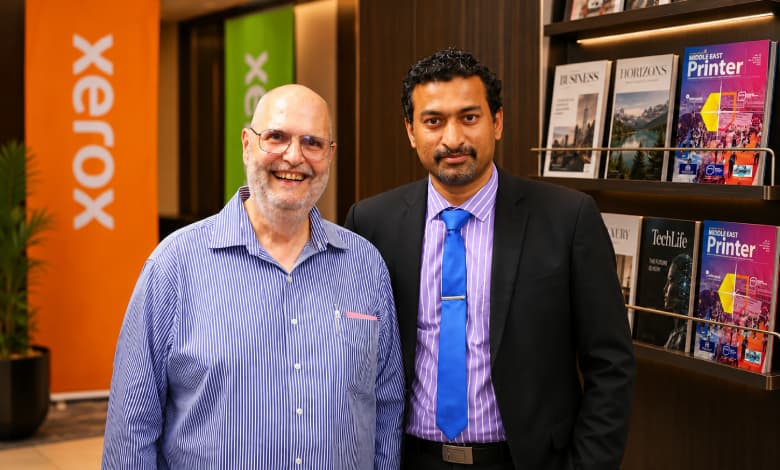
Romano’s luxury cruise trips around the world made him visit Dubai on several occasions. During his stopovers, he would actively participate in events hosted by ME Printer, sharing his observations, personal experiences, and insights about global digital printing and packaging trends to an audience featuring industry leaders from the UAE.
Numbering in their hundreds, his articles have also appeared in a variety of publications around the world, including his contributions here at ME Printer. Through his regular columns and expert commentary, he became a vital link between global innovations and regional businesses.
Romano consistently provided Middle Eastern print shops with sharp global market analysis, translating international technical trends into actionable local business strategies. His features served as technological roadmaps that successfully guided the region’s transition from conventional offset printing to high-speed digital inkjet production.
Dual Legacy Powers Printed Word
As the printing industry continues to evolve in the digital age, Frank Romano’s dual legacy of preservation and forward-looking innovation ensures that the roots of graphic communication are never forgotten. His work across global classrooms, the halls of the Museum of Printing, and through the pages of his publications and international journals stands as a monument to the enduring power of the printed word.




One Comment