


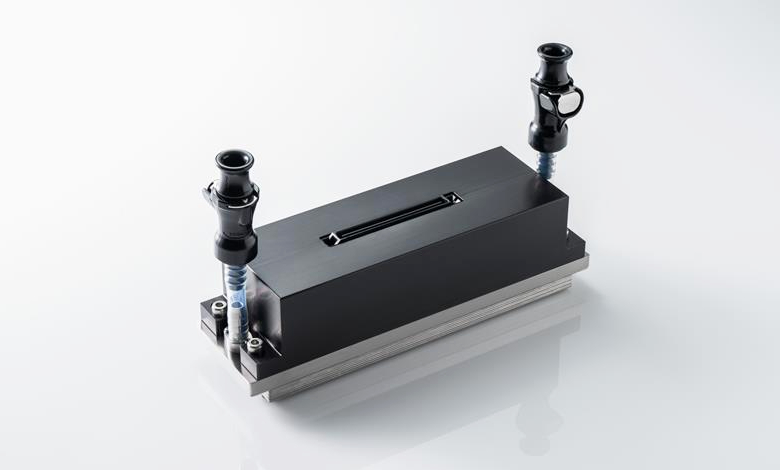
Kyocera has announced the development of a prototype inkjet printhead designed to jet high-viscosity inks and industrial fluids, a segment that continues to attract interest across packaging, textiles, electronics, and advanced manufacturing.
The printhead, currently at prototype stage, is intended to address applications that fall outside the operating range of conventional inkjet systems. Rather than focusing on high-resolution graphic output, Kyocera’s development targets scenarios where material properties, coverage, and deposition volume are more critical than fine image detail.
Context: Why High-Viscosity Inkjet Is Gaining Attention
Most commercial inkjet systems in printing and packaging operate with ink viscosities typically below 10–12 mPa·s. This range suits aqueous, solvent, and UV inks used in labels, folding cartons, and textile printing, but it restricts ink formulation and functional performance.
In recent years, manufacturers — including those in the Middle East — have shown growing interest in inkjet systems capable of handling thicker materials, such as:
- high-opacity or high-solids inks
- functional and conductive inks
- coatings, varnishes, and adhesives
- paints and resins for industrial and automotive use
- materials used in additive manufacturing
While ink heating is often used to reduce viscosity during jetting, this approach introduces system complexity and limits the range of usable materials. Against this background, Kyocera’s work focuses on expanding printhead tolerance to higher viscosities at or near room temperature.
Kyocera’s Technical Approach
According to Kyocera, the prototype is based on its existing KJ4 architecture, with two key areas of modification. First, the internal fluid channel design has been optimized to support the flow characteristics of higher-viscosity fluids. Second, the piezo actuator structure has been redesigned to increase jetting force, enabling the stable ejection of larger droplets.
Under Kyocera’s evaluation conditions, the printhead has demonstrated the ability to jet fluids with viscosities of up to 80 mPa·s, using droplets of approximately 280 pL. The effective print width is 111.69 mm, with 1,584 nozzles operating at a resolution of 360 × 360 dpi.
These specifications indicate that the printhead is intended primarily for industrial and functional applications, rather than high-detail graphic printing.
Positioning Relative to Other Printhead Manufacturers
Kyocera describes its development as an industry first within a specific technical scope. It is also worth noting that other manufacturers have previously addressed high-viscosity inkjet requirements using different design approaches.
Xaar has offered high-viscosity printhead platforms for several years, particularly for ceramics and industrial printing, while Ricoh has concentrated primarily on high-speed, lower-viscosity industrial graphics.
From a practical, application-oriented perspective, the positioning can be summarized as follows:
Comparative Overview (Industrial Perspective)
| Feature | Kyocera (Prototype) | Xaar (High-Viscosity Platforms) | Ricoh (Gen5 / Gen6) |
| Typical viscosity range | Up to ~80 mPa·s (room temperature, stated) | ~25–100 mPa·s (often with heating) | ~5–12 mPa·s |
| Typical drop volume | ~280 pL | ~6–80 pL (grayscale dependent) | ~5–21 pL |
| Resolution | 360 × 360 dpi | Up to 720 dpi | Up to 600 dpi |
| Nozzle count | 1,584 | ~1,000–2,000 (model dependent) | ~1,280 |
| Design emphasis | Material deposition, functional layers | Industrial robustness, recirculation | Speed, image quality |
| Typical applications | Coatings, AM, functional printing | Ceramics, industrial decoration | Packaging graphics, textiles |
This comparison highlights that Kyocera’s prototype is not positioned as a direct replacement for mainstream packaging or textile printheads, but rather as an option for applications where thicker materials are required.
Commercial Readiness and Market Considerations
Kyocera has indicated that the printhead is currently intended for test rigs and co-development environments. Final mounting standards, integration formats, and commercialization timelines have not yet been announced.
This development approach is consistent with Kyocera’s past practice of working with partners to refine printhead designs for specific industrial requirements before commercial release. As such, early interest is likely to come from OEMs, system integrators, and industrial manufacturers rather than conventional print service providers.
Practical Implications for Printing and Manufacturing
For packaging, textile, and industrial producers, Kyocera’s prototype illustrates a broader trend: inkjet technology is increasingly being evaluated not only as a printing process, but as a digital manufacturing tool.
Potential areas of relevance include:
- functional layers in packaging production
- digital coatings and surface treatments
- textile applications aiming to reduce pretreatment
- industrial marking and component decoration
- material jetting for tooling and additive manufacturing
At the same time, applications requiring high resolution, fine detail, or high-speed graphic output are likely to remain better served by existing low-viscosity inkjet platforms.
Summary
Kyocera’s high-viscosity inkjet printhead represents a technically significant exploration into an area of growing industrial interest. Its specifications suggest clear potential for functional and manufacturing-oriented applications, while its prototype status indicates that further development and validation will be required before wider adoption.
From an industry perspective, this development should be seen as part of a gradual expansion of inkjet’s role in industrial production, rather than an immediate shift in mainstream printing technologies.