
Global Brands Tap SGI Dubai for Rapid MEA Growth

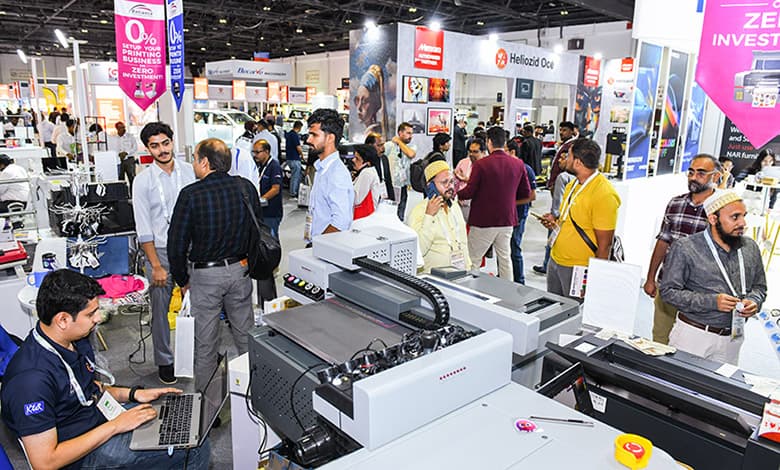
In an industry where technology cycles are compressing and customer expectations are rising, exhibitions are no longer judged by scale alone. The most valuable shows are those that consistently deliver qualified buyer access, real conversion outcomes, and a clear sense of where production, applications, and business models are heading next. For exhibitors that are seriously exploring growth outcomes in 2026, please reach out to [email protected]
That is precisely where SGI Dubai has secured its position in the region’s trade calendar. As the 29th edition approaches in 2026, SGI Dubai is not merely preparing for another year on the show floor. It is reinforcing its authority as the Middle East and Africa’s most commercially relevant platform for printing, signage, imaging, visual communication, and allied production technologies, while actively widening the international exhibitor mix that fuels innovation and competition.
For global manufacturers and solution providers, SGI Dubai’s proposition is straightforward, this is a marketplace where decision-makers arrive with defined needs, budgets, and urgency. It is a show built around real applications and real procurement, supported by a regional economy that continues to invest in retail, hospitality, transport infrastructure, destination development, real estate branding, events, and experiential environments.
A show built on outcomes, not optics
The long-term credibility of any B2B exhibition rests on what happens after the stands come down, machines sold, partnerships formed, distribution agreements signed, and pipelines built that convert into measurable revenue. SGI Dubai’s recent editions have been increasingly characterised by precisely these outcomes, particularly on the equipment side where exhibitors have reported strong on-site sales and high-intent lead generation.
In the organiser’s framing, this performance is not incidental, it is the result of a clear positioning strategy and sustained buyer confidence.
“SGI Dubai has proven, year after year, that it is the decision-makers’ show,” says Abdulrahman Falaknaz, President of International Expo-Consults (IEC), the organiser of SGI Dubai. “Exhibitors come here to meet buyers who are ready to invest, and visitors come to compare technologies and make confident purchasing decisions. That emphasis on purchase intent matters, especially as the global print industry continues to evolve towards shorter runs, faster turnaround, greater personalisation, and tighter integration between print and digital customer experiences. In such an environment, a successful exhibition is less about showcasing standalone equipment and more about enabling end-to-end capability upgrades—across print, finishing, workflow, content, display, and fabrication.”
The macro trend – print is evolving, and investment is rising
Far from being a legacy industry, print is undergoing a structural transformation driven by automation, sustainability requirements, and new application demand, from décor and retail environments to packaging, labels, and industrial printing.
This is reflected in global market signals. For example, printing machinery demand is expected to expand over the coming decade, as per Allied Market Research, pointing to steady equipment investment even as technology shifts towards more versatile, more efficient, and more sustainable production systems.
Equally important are the adjacent segments that now converge on the SGI Dubai show floor:
- Digital signage and LED ecosystems are expanding rapidly as brands invest in retail media networks, destination experiences, and smart environments, as per Grand View Research.
- Digital textile printing continues to rise on the back of sustainability goals and on-demand production economics, as per Grand View Research.
- Large-format printing is expected to grow further as applications widen across retail, events, real estate marketing, interiors, and outdoor branding, as per MarketsandMarkets research.
The implication for exhibitors is clear, buyers increasingly want integrated solutions that can serve multiple application categories with predictable quality, high uptime, and commercially viable operating models.
Why the Middle East and Africa is a growth thesis global exhibitors cannot ignore
The Middle East and Africa is not one market, it is a connected corridor of diverse economies with a common thread – large scale development and brand-building activity that directly fuels demand for print, signage, displays, and fabrication.
From the Gulf’s retail and hospitality pipeline to Africa’s fast-growing urban centres, the requirement for visual communication is expanding. Commercial displays, digital signage, and integrated wayfinding are rising in parallel, driven by new malls, airports, mixed-use developments, transport systems, and destination venues.
Market indicators reinforce this direction:
- The Middle East and Africa commercial display market is projected to expand meaningfully through 2030, as per Grand View Research.
- Africa’s printing market is projected to grow steadily through 2030, as per 6Wresearch.
- The Middle East and Africa digital signage solutions market is expected to continue growing at a strong pace, as per Straits Research.
Dubai’s role as a distribution and partnership gateway makes SGI Dubai particularly valuable for global exhibitors. A single exhibition investment can unlock conversations spanning the UAE and GCC, North Africa, East Africa, and parts of the Levant and Central Asia markets that, in many cases, prefer to procure through Dubai-based distributors and regional integrators.
This is one of the reasons SGI Dubai has retained strong pull for international visitors and buyers – it is often the most efficient route for multi-market access.
“Dubai’s advantage is connectivity—logistics, business confidence, and regional reach,” adds Falaknaz. “SGI Dubai sits at the centre of that. Global exhibitors are not just selling into one country; they are building reach across the Middle East and Africa from one platform.”
International participation is widening—and that is a strategic signal
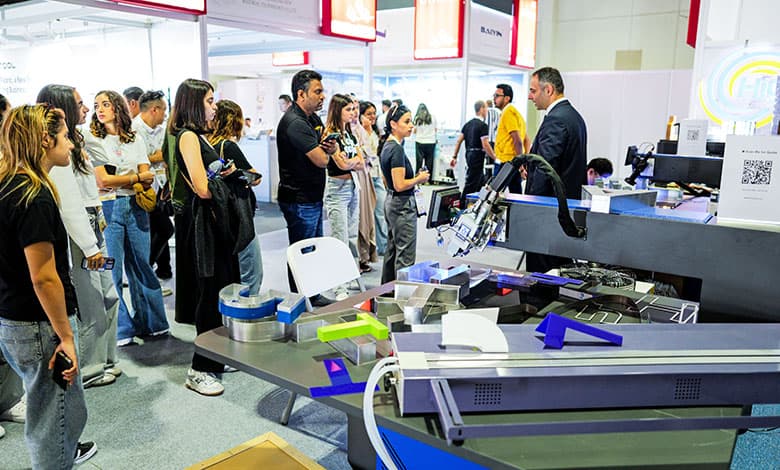
One of the clearest measures of SGI Dubai’s international momentum has been the growing diversity of exhibitor origin markets and the increasing importance of country pavilions. Pavilions tend to emerge when two conditions are met – an organiser can demonstrate commercial conversion, and a market can justify sustained participation by clusters of manufacturers.
Recent editions have seen new national pavilion participation and expanded global interest, an indicator that SGI Dubai is being taken seriously not only as a regional show, but as a global route to market.
“SGI Dubai has always been where global innovation meets regional opportunity,” notes Falaknaz. “Our focus for 2026 is to make the platform even more international, more diverse in technology, and more aligned to what buyers in this region need next.”
For exhibitors, this expansion creates a healthy competitive environment, more choice for buyers, stronger benchmarking, and higher expectations around demonstration quality, service models, and application support.
The show profile – aligned to how buyers actually spend
The most effective exhibitions are those that reflect how buyers operate in real life. Print businesses and visual communication suppliers are no longer built around one technology lane. They compete by blending capabilities, wide-format, textile, finishing, display, fabrication, software, and increasingly, automation and data.
SGI Dubai’s show profile is built around this convergence. In SGI Dubai 2026, exhibitors and visitors can expect a cross-section spanning:
- Large-format and wide-format printing technologies
- Digital textile printing and soft signage
- Digital signage, LED systems, and display solutions
- 3D printing and additive manufacturing applications
- CNC routing, laser cutting, engraving, and fabrication
- Sign-making materials, inks, substrates, and finishing solutions
- Labelling, packaging, coding, and marking systems
- Workflow software, colour management, automation, and emerging artificial intelligence applications
- Retail display solutions and point-of-sale production ecosystems
- Sustainability-oriented innovations across inks, materials, energy usage, and waste reduction
This breadth is not a matter of scale; it is a commercial necessity. Buyers increasingly want to assess complete production ecosystems, not only machine specifications. They want to understand throughput, lifecycle operating costs, service support, training, workflow integration, and the kinds of applications that will drive revenue in the next 24–36 months.
Large-format printing – the cornerstone category evolving fast
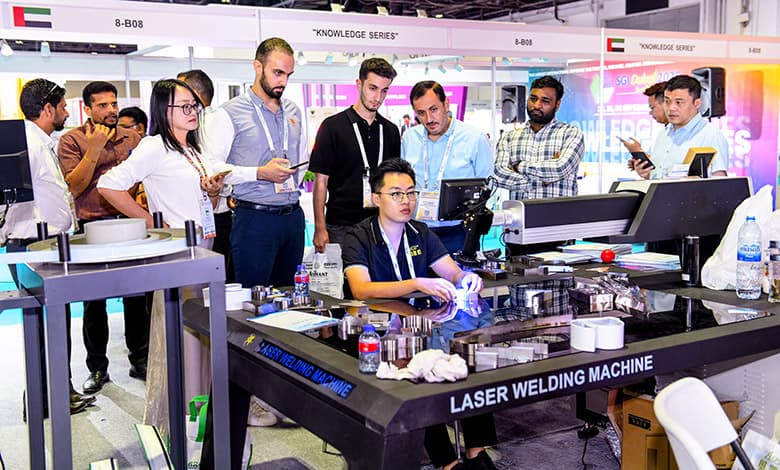
Large-format remains a primary investment area in the Middle East and Africa because it directly serves the region’s most active demand engines: retail activation, real estate branding, tourism, events, outdoor advertising, and destination development. What has changed is the buyer’s evaluation framework.
Speed and quality are no longer differentiators—they are baseline expectations. Buyers now ask harder questions:
- Can the system support multiple application types without compromising output quality?
- How does the ink and substrate mix align to sustainability and regulatory expectations?
- What is the true uptime performance, and how strong is the local service ecosystem?
- How effectively does the workflow integrate prepress, colour, finishing, and installation requirements?
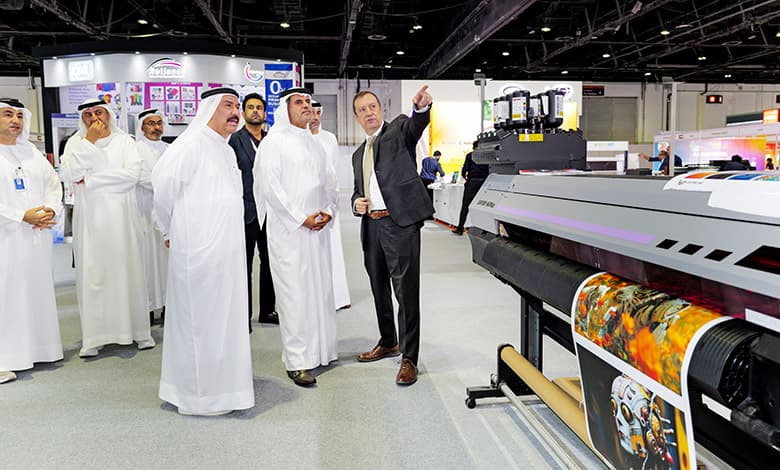
This is where SGI Dubai performs strongly, it allows buyers to compare technologies side-by-side and to engage with suppliers in the context of their real application portfolio. For exhibitors, it means the discussion is more advanced—often moving quickly from “what the machine can do” to “how the machine makes money.”
Textile printing – moving beyond fashion into interiors and branded environments
Digital textile printing in the region is expanding across three drivers, sustainability requirements, faster product cycles, and the growing economics of on-demand production. While fashion remains important, it is not the only story.
Interiors, soft signage, branded environments, and décor applications are becoming major demand channels. Hospitality projects, premium retail fit-outs, and event environments increasingly use textiles for flexibility, visual impact, and speed of installation. For print service providers, textile capability is becoming less of a niche add-on and more of a strategic growth lever.
As per Grand View Research, digital textile printing is expected to continue expanding through 2030, underlining why this category is drawing more equipment investment and more supplier innovation globally.
For SGI Dubai 2026, textile is likely to remain one of the most strategically important show zones, particularly for exhibitors offering integrated solutions: printers, heat transfer systems, inks, fabrics, finishing, and workflow support.

Digital signage and LED: the convergence shaping the buyer’s next decisions
Visual communication today increasingly blends printed graphics with digital display networks. Retail brands, airports, malls, hospitality venues, and transport operators are deploying digital signage not simply for “display,” but as part of broader customer experience ecosystems.
This has two implications for SGI Dubai exhibitors;
- Buyers want integrated propositions – hardware, content management, installation, maintenance, and performance optimisation.
- Print businesses are increasingly partnering with audiovisual integrators to offer end-to-end delivery, print plus LED, print plus interactive, print plus experiential environments.
As per Grand View Research, global digital signage is projected to expand significantly through 2030, and the Middle East and Africa is moving in the same direction—with strong commercial display demand supported by destination growth and infrastructure programmes.
This convergence is reshaping the profile of visitors at SGI Dubai, beyond print service providers, it includes retail groups, project owners, mall operators, fit-out firms, architects, and integrators seeking complete solutions.
3D printing and additive manufacturing – from novelty to practical advantage
Additive manufacturing is moving into real commercial workflows across architecture, education, healthcare, prototyping, and customised production components. In the Middle East, this intersects with smart manufacturing ambitions and the region’s interest in digital production ecosystems. Within SGI Dubai’s broader ecosystem, 3D printing is also linked to signage, fabrication, and retail display production—enabling rapid prototyping, customised fixtures, and shorter development cycles.
For global exhibitors in this space, SGI Dubai offers a buyer base that includes not only print businesses, but also architects, interior designers, engineers, education providers, and industrial users looking for practical production outcomes.
Knowledge and capability building – keeping the show aligned to the future
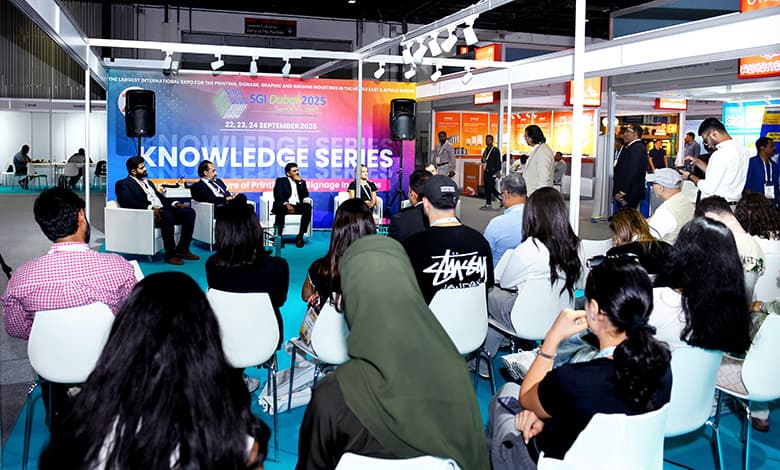
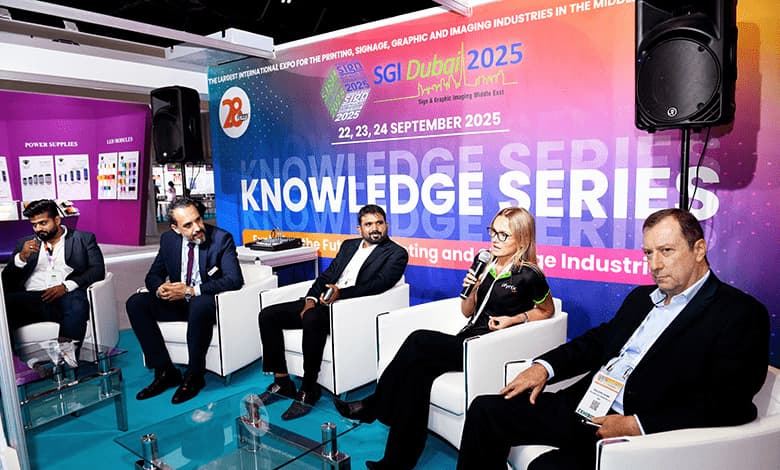
SGI Dubai’s authority is reinforced when it offers more than product display, when it advances industry conversations and capability. Recent programming has increasingly focused on the operational realities that decision-makers care about:
- Workflow optimisation and automation
- Reducing waste and improving sustainability outcomes
- Faster turnaround and better job costing discipline
- Workforce skills and training as a competitive differentiator
- Artificial intelligence applications that improve efficiency and creativity
The attention on artificial intelligence is particularly relevant. As the industry shifts towards data-driven workflow management, predictive maintenance, automated prepress, and smarter production planning, buyers are expecting vendors to show not only equipment performance but the intelligence layer around it.
For exhibitors, this creates a stronger engagement model, conversations that begin with a technology demo can quickly move into ROI logic, operational implementation plans, and scalable growth strategies.
The exhibitor case for SGI Dubai 2026 – access, conversion, and multi-market reach
For manufacturers and solution providers planning 2026, the case for SGI Dubai can be summarised in three strategic advantages.
First, buyer quality. SGI Dubai’s proposition is built around decision-makers—owners, general managers, procurement heads, and technical leaders who attend to evaluate technologies and make purchases.
Second, multi-market leverage. SGI Dubai is not a single-country play. It is a gateway into the wider Middle East and Africa corridor—where Dubai remains a preferred hub for procurement, distribution, logistics, and partnership formation.
Third, a converged show profile. SGI Dubai brings together the full ecosystem: print, signage, textiles, LED and displays, fabrication, software, and emerging technologies such as additive manufacturing and artificial intelligence. That reflects how buyers invest today—across complete solutions rather than isolated machines.
As Falaknaz put it, “We are extremely bullish about SGI Dubai 2026. The interest we are seeing from exhibitors is early and global. Our goal is to deliver a show that is bigger in participation, stronger in technology diversity, and even more aligned to future-facing buyer demand.”

A clear message to global exhibitors
For brands assessing where to invest exhibition budgets in 2026, SGI Dubai stands out for a simple reason – it is a show where commercial outcomes are the organising principle.
It sits at the intersection of three powerful forces: a region still investing in destination infrastructure and brand environments; an industry evolving through automation and sustainability pressures; and a buyer base that increasingly values integrated solutions—print plus display, print plus fabrication, print plus workflow intelligence.
The 29th edition in 2026 arrives at a moment when global manufacturers are rethinking route-to-market strategies and regional growth allocation. For those targeting the Middle East and Africa, SGI Dubai is positioning itself not just as a place to exhibit, but as the platform where regional demand becomes measurable opportunity—through distribution relationships, project pipelines, equipment sales, and long-term market presence.
If exhibitions are ultimately about deals, partnerships, and influence, SGI Dubai’s message to the global market is clear, this is where the region’s next wave of print and visual communication decisions will be shaped—and where the most serious buyers come to choose what they will invest in next.



One Comment