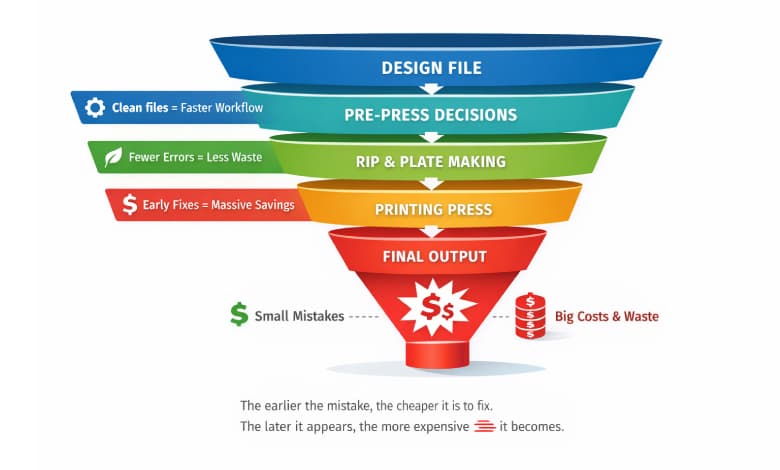
Pre-press is no longer just a technical checkpoint between design and print. In today’s Middle Eastern production environment, it has become a decision-making layer—one that directly impacts how efficiently a job runs, how much waste it generates, and ultimately, how profitable it is.
Here’s a breakdown of the core pre-press elements—not just what they are, but why they matter now more than ever.
- Artwork & File Preparation
What it is: The original design file created in software like Illustrator or InDesign.
Why it matters today:
- Automation: Clean, standardized files integrate seamlessly into automated workflows.
- Sustainability: Fewer file errors = fewer reprints and less material waste.
- Cost: Poorly prepared files lead to delays, manual corrections, and increased labor costs.
In modern workflows, a “bad file” is no longer a small issue—it’s a production bottleneck.
- Resolution (DPI/PPI)
What it is: The level of detail in an image (typically 300 DPI for print).
Why it matters today:
- Automation: High-resolution assets ensure smooth processing in RIP systems.
- Sustainability: Avoids reprints caused by pixelated outputs.
- Cost: Low-resolution errors often go unnoticed until printing—when it’s already expensive.
- Color Management (CMYK, RGB, ICC Profiles)
What it is: Controlling how colors appear from screen to print.
Why it matters today:
- Automation: Consistent color profiles allow repeat jobs without manual correction.
- Sustainability: Accurate color reduces trial-and-error print runs.
- Cost: Color mismatches = rejected jobs, wasted ink, and unhappy clients.
Color errors are one of the most expensive “invisible mistakes” in pre-press.
- Spot Colors & Brand Accuracy (Pantone)
What it is: Pre-defined colors used for exact brand matching.
Why it matters today:
- Automation: Standardized color libraries simplify repeat production.
- Sustainability: Reduces trial prints for color matching.
- Cost: Brand inconsistencies often lead to job rejection and reprints.
- Bleed, Trim & Safe Area
What it is: Margins that account for cutting tolerances.
Why it matters today:
- Automation: Essential for automated cutting and finishing systems.
- Sustainability: Prevents miscuts that result in waste.
- Cost: A missing bleed can ruin an entire batch—especially in packaging runs.
- Imposition
What it is: Arranging multiple pages or designs efficiently on a sheet.
Why it matters today:
- Automation: Software-driven imposition reduces manual planning.
- Sustainability: Maximizes sheet usage, minimizing material waste.
- Cost: Better imposition = fewer sheets = lower production cost.
Smart imposition is one of the easiest ways to improve margins instantly.
- Preflight Check
What it is: Automated file inspection before printing.
Why it matters today:
- Automation: First line of defense in automated workflows.
- Sustainability: Stops flawed jobs before they consume resources.
- Cost: Prevents expensive last-minute corrections or press stoppages.
- Fonts & Outlining
What it is: Ensuring text displays correctly during printing.
Why it matters today:
- Automation: Missing fonts break automated workflows.
- Sustainability: Avoids reprints due to layout errors.
- Cost: Fixing font issues mid-production wastes time and money.
- Trapping
What it is: Slight overlap between colors to prevent gaps.
Why it matters today:
- Automation: Built into modern RIP workflows.
- Sustainability: Prevents rejects due to misregistration.
- Cost: Even minor gaps can lead to entire batch rejection in packaging.
- Raster vs Vector Graphics
What it is: Pixel-based vs scalable graphics.
Why it matters today:
- Automation: Vector files scale seamlessly across formats.
- Sustainability: Prevents quality issues that cause reprints.
- Cost: Poor graphic choice leads to unusable output.
- RIP (Raster Image Processor)
What it is: Converts design files into printable data.
Why it matters today:
- Automation: Core engine of digital workflows.
- Sustainability: Efficient RIP processing reduces trial runs.
- Cost: Errors at this stage affect the entire print job.
- Separations & Plates (CTP)
What it is: Breaking files into CMYK layers and creating printing plates.
Why it matters today:
- Automation: Modern CTP systems are highly automated—but only as good as the input file.
- Sustainability: Plate remakes waste materials and chemicals.
- Cost: Plate errors are expensive and time-consuming.
- Overprint & Knockout
What it is: How colors interact when layered.
Why it matters today:
- Automation: Requires correct setup to avoid unexpected output.
- Sustainability: Prevents reprints caused by invisible design errors.
- Cost: A wrong overprint setting can ruin an entire production run.
- Gamut & Color Limitations
What it is: The range of colors a printer can produce.
Why it matters today:
- Automation: Helps predict output accurately.
- Sustainability: Reduces trial-and-error printing.
- Cost: Out-of-gamut colors lead to dissatisfaction and rework.
- Registration
What it is: Aligning all color layers perfectly.
Why it matters today:
- Automation: Precision alignment is critical in high-speed presses.
- Sustainability: Misalignment leads to rejected prints.
- Cost: Even slight misregistration can make products unusable.
- Dielines (Packaging)
What it is: Templates for cutting, folding, and gluing.
Why it matters today:
- Automation: Essential for automated finishing systems.
- Sustainability: Incorrect dielines waste board and materials.
- Cost: Packaging errors are among the most expensive mistakes.
- Step & Repeat
What it is: Repeating designs across a sheet.
Why it matters today:
- Automation: Widely used in label and packaging workflows.
- Sustainability: Optimizes material usage.
- Cost: Directly reduces per-unit production cost.
Pre-Press as a Strategic Function
What ties all of this together is a simple but critical shift:
Pre-press is no longer a support function.It is a strategic control point.
In a region where automation is accelerating, sustainability targets are tightening, and margins are under constant pressure, the smallest pre-press decision can have a multiplied impact on the entire production chain.
For Middle Eastern printers competing on both regional and global stages, success will increasingly depend not just on press capabilities—but on how intelligently jobs are prepared before they ever reach the press.