By: Duaa Saeed
The packaging industry in Sudan has always played a vital role in supporting manufacturing, food security, agriculture, trade, and consumer markets. Packaging is more than a container around a product. It protects goods, extends shelf life, supports branding, improves logistics, reduces damage, and enables products to move safely from factories to consumers. For a country like Sudan, where agriculture, food processing, flour milling, animal feed, beverages, pharmaceuticals, detergents, and export commodities are key economic activities, packaging is an essential part of industrial development.
Before the war, Sudan had a sizeable and diverse packaging market, supported by strong demand from food, beverages, flour, agriculture, cement, animal feed, detergents, and other essential industries. Major segments such as flexible packaging, corrugated cartons, PP woven bags, PE shrink film, paper bags, and labels were already serving a wide industrial base.
Pre-war figures indicate the scale of this demand, with flexible packaging estimated at around 21,681 MT, corrugated cartons at around 64,000 MT, and PP woven bags exceeding 103 million pieces, with a combined value of more than USD 313 million. This shows that packaging was already a strategic sector with established demand, local production capability, and strong links to Sudan’s core industries.
The war disrupted operations and supply chains, but it did not reduce the importance of packaging. In fact, the need for reliable local packaging became even stronger as imports became more difficult and manufacturers looked for more resilient local supply options.
The war has placed heavy pressure on Sudan’s industrial sector. Many factories faced damage, looting, interruption of utilities, unstable power supply, shortage of spare parts, transport difficulties, banking constraints, loss of skilled workers, and high operational costs. Restarting operations after such disruption is not easy. Packaging factories often require machinery inspection, electrical repairs, spare parts, cleaning, calibration, raw material sourcing, team rebuilding, and reliable energy supply before returning to stable production.
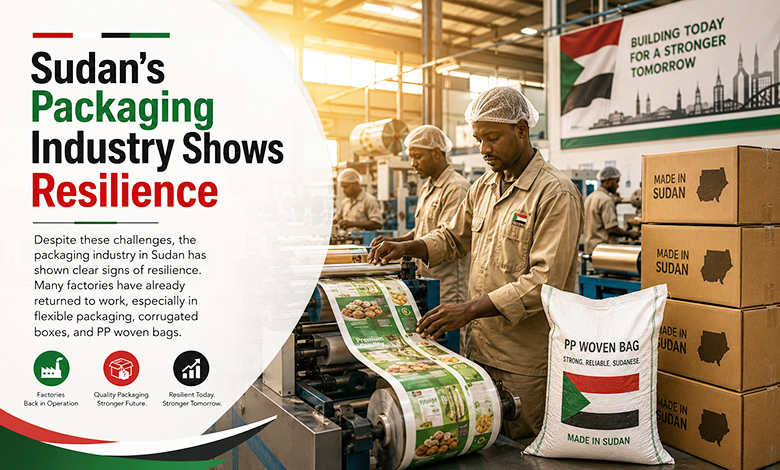
Despite these challenges, the packaging industry in Sudan has shown clear signs of resilience. Many factories have already returned to work, especially in flexible packaging, corrugated boxes, and PP woven bags. This is an important positive signal for the wider manufacturing sector. These segments are closely linked to essential goods such as flour, sugar, food products, animal feed, agricultural inputs, beverages, detergents, and industrial products. Because these products are needed by the market every day, packaging demand has remained active even during difficult conditions.
This recovery also shows the strength of local industrial capability. Pre-war data indicated that a large share of corrugated cartons and PP woven bags was already produced locally. This means Sudan had an existing foundation for local packaging production before the war. The return of many packaging factories today builds on that foundation and highlights the sector’s ability to adapt under pressure.
Foreign exchange fluctuation remains one of the biggest challenges facing packaging producers. Many packaging inputs still depend on imported raw materials, including paper, polymers, inks, adhesives, spare parts, and machinery consumables. When the Sudanese pound weakens, production costs increase rapidly, and quotation validity becomes difficult to manage. This creates pressure on producers and customers alike, especially in a market where pricing stability is difficult.
For local packaging producers, this situation creates both difficulty and opportunity. The difficulty is that many raw materials and technical inputs are still imported. Any restriction, delay, or currency movement affects cost and production continuity. The opportunity is that manufacturers are increasingly looking for local packaging sources instead of relying fully on imported finished packaging. This gives Sudanese packaging producers a stronger role in the national supply chain, especially if policies supporting local manufacturing are applied in a balanced way.
Recent government direction to support local production and reduce import pressure may become an important driver for the packaging sector. Import-substitution policies can encourage local sourcing, protect domestic industries, create jobs, and reduce dependency on imported finished goods. However, the success of this approach depends on ensuring that local factories can still access essential raw materials, spare parts, machinery, and production inputs that are not yet available locally. Supporting local manufacturing should mean enabling factories to produce more, not limiting their access to what they need to operate.
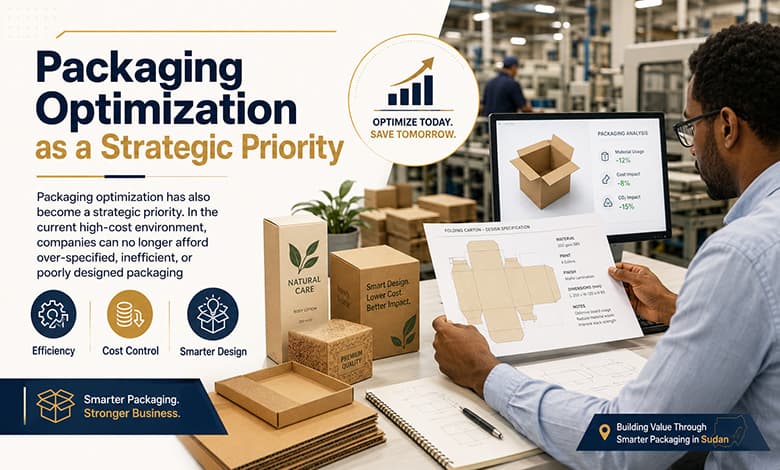
Packaging optimization has also become a strategic priority. In the current high-cost environment, companies can no longer afford over-specified, inefficient, or poorly designed packaging. Optimization means choosing the right packaging design, size, strength, and performance level for the product and its supply chain. It also includes improving palletization, truck loading, warehouse utilization, material efficiency, production waste, and product protection.
The impact of packaging optimization can be significant, especially in a market where cost, logistics, and material availability are under constant pressure. During the war, many packaging development projects had to focus not only on cost reduction, but also on keeping supply chains moving under difficult conditions. One practical example was the redesign of corrugated box configuration and packaging material structure, which improved truck loadability and reduced logistics cost, generating annual savings of around USD 1 million. This kind of optimization shows how packaging decisions can directly influence business continuity, transport efficiency, and overall competitiveness. Beyond logistics, suitable flexible packaging structures can reduce unnecessary material cost while maintaining product protection and shelf life, while well-designed woven bags can minimize breakage, complaints, and product loss. In this sense, packaging optimization is not only a technical exercise; it is a strategic business tool that supports cost control, operational resilience, and supply continuity.
Sustainability is another important direction for the future. Although Sudan’s immediate priority is industrial recovery, the long-term packaging trend will move toward recyclable materials, reduced material consumption, paper-based alternatives where suitable, recycled content, and better waste management. Sustainability should not be viewed only as an environmental requirement. It can also support efficiency, reduce waste, lower cost, and improve the use of local resources.
There are several opportunities for investment and growth in Sudan’s packaging industry. The first is the rehabilitation and modernization of existing factories. Many producers need machinery upgrades, better controls, improved utilities, and stronger maintenance systems. The second opportunity is technical capability development, including operator training, packaging design knowledge, quality systems, and testing laboratories. The third is supplier development, where packaging producers and manufacturers work together to improve specifications, reduce cost, and increase local sourcing.
There is also potential for regional growth. Sudan has strong agricultural resources and a strategic location connected to African and Arab markets. As stability improves and production capacity recovers, packaging will be essential for export readiness. Good packaging helps reduce damage, improve shelf appearance, meet customer requirements, and build confidence with Sudanese products.
The future outlook for Sudan’s packaging industry is cautiously optimistic. The challenges remain real, especially around foreign exchange, raw material supply, infrastructure, utilities, power supply, and working capital. However, the return of many factories to operation proves that the sector is resilient. The pre-war figures also show that Sudan had a strong packaging demand base and meaningful local production capability. This gives the industry a real foundation for recovery.
Sudan’s packaging industry has been tested by crisis, but it has not stopped. Its gradual return to operation is a positive sign for the wider manufacturing sector. With the right investment, policy support, technical development, and collaboration between producers and customers, packaging can become a strategic driver of industrial recovery, import substitution, food security, and regional trade.

About the Author
Duaa Saeed is a Packaging Operations and Development Manager at DAL Group, with over eight years of experience in FMCG packaging. She holds an MSc in Chemical Engineering and specializes in packaging development, cost optimization, supplier development, operations, and sustainability. Her expertise spans flexible packaging, corrugated cartons, PP woven bags, paper bags, rigid plastics, and packaging optimization projects that support stronger, more resilient supply chains.
About DAL Group
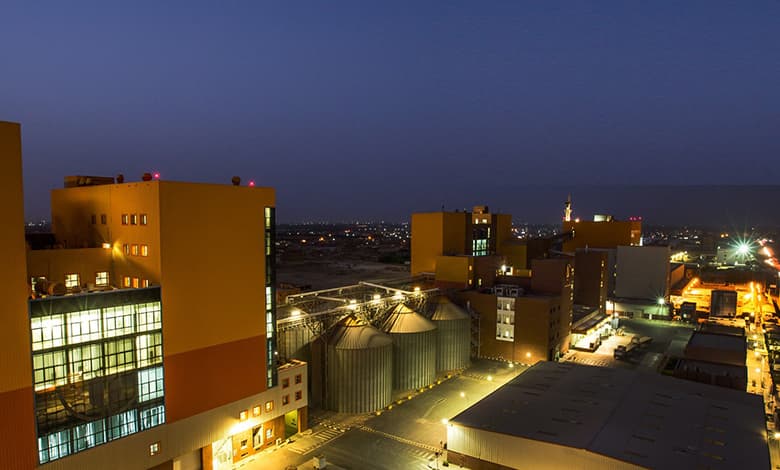
DAL Group is one of Sudan’s largest and most diversified privately owned conglomerates, with roots dating back to 1951. Active across food and beverages, agriculture, engineering, healthcare, energy, mining, education, and other sectors, the group plays a major role in Sudan’s industrial ecosystem. Through its wide packaging requirements and in-house packaging-related capabilities, DAL Group supports local manufacturing, supply-chain resilience, material efficiency, and the broader development of Sudan’s packaging industry.