By Brotherhood for Paper Industry
A print shop owner calls, frustrated: “You quoted me this price ten days ago. Why has it changed?” It’s one of the most common conversations in Egypt’s paper trade — and it rarely has anything to do with the supplier changing their mind. It has to do with a chain of events that starts at a pulp mill in Scandinavia or Brazil, moves through container shipping lanes, crosses currency markets, and only then arrives at a Cairo warehouse door.
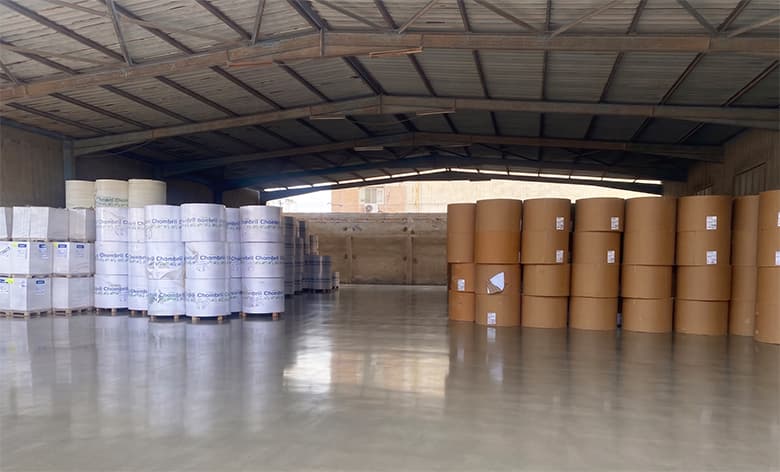
Brotherhood for Paper Industry has imported and distributed paper in Egypt since 1975, from warehouses in Faggala, Zeitoun, and Obour City, supplying woodfree, coated, carbonless, and specialty papers to print shops, publishers, and packaging businesses. Being on the receiving end of that international supply chain — and having to explain its swings to customers every week — gives a particular view of two forces that shape nearly every quote we give: currency movement and shipping disruption.
Currency: The First Number That Moves
International paper is priced in USD or EUR. When Brotherhood Paper buys from mills like Champion, Hansol, or Soporset, the transaction settles in hard currency — the Egyptian pound only enters the picture at the final step, when we invoice a local customer. That means every time the EGP weakens against the USD, the EGP cost of imported paper rises, even if the mill’s dollar price hasn’t moved at all.
This isn’t a hypothetical. After Egypt’s shift to a more flexible exchange rate in March 2024, the pound moved from roughly EGP 30.85/USD to around EGP 49.4/USD. To put that in concrete terms: on a 100-tonne order of 80 GSM woodfree offset priced at USD 850/tonne, a shift from EGP 49/USD to EGP 54/USD — just a 10% currency move — adds roughly EGP 425,000 to the same shipment, same paper, same mill price. The only variable that changed was the exchange rate.
This is the conversation we have with customers constantly: the price didn’t move because we wanted it to. If the currency moved, the EGP price had to move with it. It’s also why we tell buyers that when the EGP is stable, it’s the moment to lock in volume — and when it’s under visible pressure, no supplier can responsibly hold a quote open for weeks, because the risk isn’t ours to absorb alone.
Shipping and Import Disruption: The Delay You Don’t See Coming
The second force is less visible day-to-day but can hit just as hard: what happens to paper between the mill and the port. Paper from Asian mills either transits the Suez Canal or, when that route is disrupted, sails the much longer route around Africa’s Cape of Good Hope — adding real weeks to lead time before a single sheet reaches Egypt.
The Red Sea disruptions of 2024 were a direct lesson in this. Suez Canal trade dropped roughly 50% year-on-year in the first two months of that year, and vessels rerouted around the Cape added 10 days or more to delivery times on average. Freight rates on affected lanes didn’t just rise — they became unpredictable, sometimes jumping from roughly USD 1,500 to USD 6,000 per container almost overnight. On a single 24-tonne container of woodfree offset, that difference alone adds close to USD 190 per tonne to landed cost, before the mill price has moved at all.
What makes this genuinely difficult to manage is the lag. When a disruption happens at origin — a canal slowdown, a port delay, a rerouted vessel — paper already in transit keeps arriving for weeks. Warehouse stock looks normal. Prices hold. Then, six to twelve weeks later, the pipeline runs dry: new shipments haven’t replaced the delayed ones, stock drops below comfortable levels, and prices move locally — not because the mill raised its price, but because the paper simply isn’t there yet. By the time a customer notices the shortage, the disruption that caused it may already be over on the other side of the world.

What This Means for How We Work with Customers
These two forces — currency and shipping — are why the most useful thing a wholesaler can offer isn’t always the lowest quoted price. It’s early information: real visibility into current stock levels, honest lead-time expectations, and a willingness to say “your grade is getting tight, order now” before it becomes a crisis instead of a heads-up.
The Tool We Built to Solve This
Explaining a price change after the fact was never good enough for us — by the time a customer hears “prices went up,” the decision that would have helped them (ordering last week, locking in a quote before a shipment was delayed) has already passed.
So we built a paper price intelligence tool, live now at brotherhoodpaper.com/paper-prices-egypt/, that puts the same information we use internally directly in front of buyers.
It tracks three things in one place: the EGP/USD exchange rate and its recent trend, the status of shipping chokepoints that affect paper imports into Egypt (Suez Canal conditions, major freight route disruptions), and pulp cost movement at the mill level. Instead of a customer hearing “prices changed” as an unexplained fact, they can see for themselves which of the three forces moved, by how much, and judge whether it’s temporary or likely to persist.
In practice, this changes the conversation from reactive to proactive. A packaging buyer watching the tool can see currency pressure building before their next order and decide to buy ahead of a price move rather than after it. A print shop tracking shipping disruption status can ask us about stock levels on a specific grade before it tightens, instead of discovering a shortage when a job is already on press. That’s the actual point of the tool — not to predict the market perfectly, but to remove the information gap that makes price changes feel arbitrary when they’re not.
The Practical Takeaway
None of this means Egypt’s paper market is chaotic — it’s a mature trade, and most weeks are genuinely stable. But when currency or shipping conditions shift, they shift fast, and the businesses that handle it best are the ones with a real relationship with their supplier: asking about stock levels between orders, not just when placing one, and treating a longer-than-usual lead-time quote as the early warning signal it actually is, rather than waiting for a formal price increase notice that, by definition, always arrives too late to act on.
About Brotherhood for Paper Industry
Brotherhood for Paper Industry is a wholesale paper importer and distributor based in Cairo, Egypt, supplying print shops, publishers, and packaging businesses across the country since 1975.