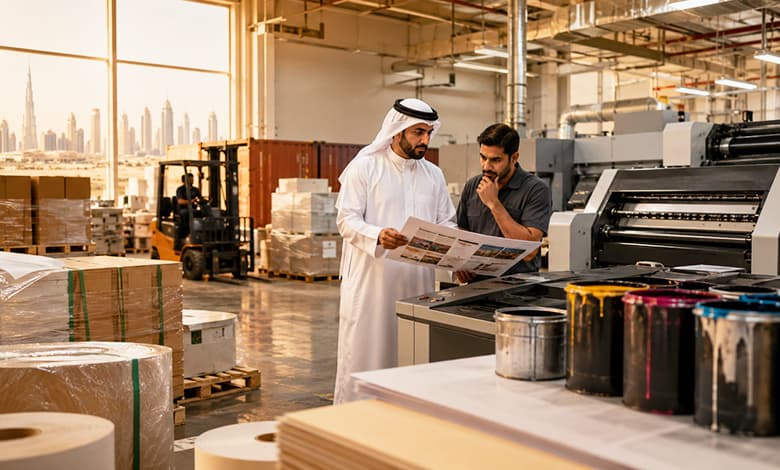
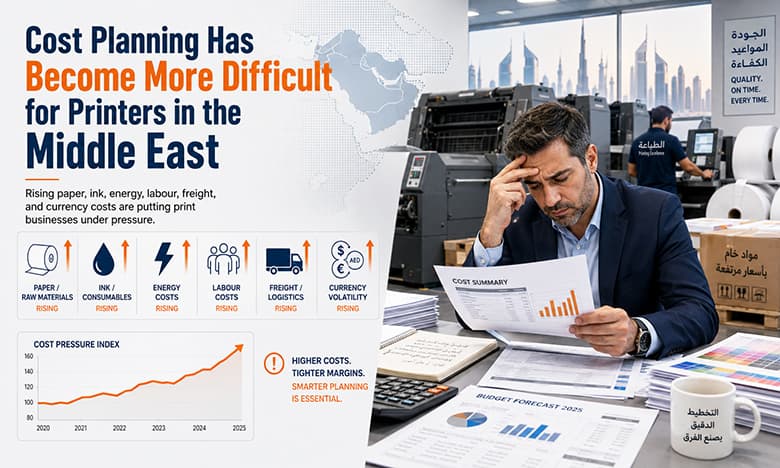
Higher print costs are no longer a temporary disruption. For print service providers, converters, publishers, packaging producers, and brand owners across the Middle East, cost pressure has become a permanent business reality. Paper, ink, plates, substrates, energy, labour, logistics, finance, and imported spare parts are all becoming more expensive or more unpredictable. The challenge is not only that costs are rising, but that they are rising together.
For the Middle East, this issue is especially important. The region depends heavily on imported paper, printing equipment, consumables, inks, chemicals, plates, and spare parts. Any disruption in global shipping, currency movements, energy pricing, or international trade quickly affects local production costs. At the same time, demand for packaging, labels, signage, commercial print, publishing, and personalised print continues to grow, driven by population growth, retail expansion, e-commerce, tourism, food delivery, healthcare, and industrial diversification.
A Regional Market Facing Global Pressure
In many Middle Eastern markets, printers operate in a complex environment. They must manage local competition while also dealing with international supply chain pressures. Paper and board may be sourced from Europe or Asia, inks and consumables may come from global suppliers, and machinery often depends on imported spare parts and overseas technical support.
This means that global disruptions can quickly become local business problems. A delay in shipping, a change in exchange rates, a rise in freight costs, or a shortage of a specific substrate can affect production schedules and profit margins. For printers working on tight deadlines, especially in packaging, labels, publishing, and event-related print, such disruptions can be costly.
The Middle East is also a highly active market. Saudi Arabia’s Vision 2030 projects, the UAE’s position as a regional business and events hub, Qatar’s hospitality and infrastructure sectors, and the growth of retail and consumer markets across the GCC all continue to create demand for print. However, this demand is now developing in a more cost-sensitive environment.

Why Cost Planning Has Become More Difficult
In the past, many printers could absorb moderate cost increases or adjust prices gradually. That approach is becoming harder. Today’s cost pressures are connected. Higher logistics costs can increase the price of imported substrates. Currency movement can affect machinery, consumables, and service contracts. Labour costs can rise at the same time as energy, rent, and financing costs.
As a result, printers can no longer rely on old pricing models. A job that appears profitable at the quotation stage may become less profitable by the time materials are purchased and production begins. This is especially true for long-term contracts, government tenders, book printing, packaging supply agreements, and repeat orders with fixed pricing.
For Middle East printers, cost planning now requires greater discipline. Quotation validity periods may need to be shorter. Material prices must be reviewed more frequently. Procurement teams need to work more closely with production and sales teams. The ability to monitor costs in real time is becoming increasingly important.
Not Every Printer Feels the Impact Equally
Cost pressure affects the entire industry, but not every company experiences it in the same way. Smaller commercial printers, copy centres, sign makers, and family-owned print shops are often more exposed. They may not have the purchasing power to negotiate better material prices or the financial strength to hold large stock. Many also rely more heavily on manual processes, which can increase waste and reduce efficiency.
Larger print companies and packaging converters are usually better positioned. They can purchase materials in larger quantities, invest in automation, negotiate stronger supplier agreements, and spread fixed costs across higher production volumes. Companies with strong digital production capabilities are also better placed to handle shorter runs, faster turnaround times, and personalised work.
However, size alone is not enough. Even large companies can face pressure if they depend on outdated workflows, weak cost control, or price-based competition. In today’s market, efficiency, flexibility, and financial discipline matter as much as production capacity.

How Customers Are Rethinking Print Orders
Rising costs are also changing the behaviour of print buyers. Across the Middle East, many customers are reviewing how much they print, how often they print, and what type of print they really need.
In sectors such as retail, education, publishing, real estate, hospitality, and events, buyers are becoming more selective. Some are reducing print quantities. Others are shifting from large-volume general print to targeted campaigns, short-run digital print, personalised communication, or premium printed materials that create stronger impact.
This does not mean print is losing relevance. It means that print must prove its value more clearly. Customers are less willing to spend on print that has no clear purpose. They are more willing to invest in print that supports sales, improves brand image, enhances packaging, increases customer engagement, or creates a memorable physical experience.
For PSPs, this shift creates a new responsibility. They must move beyond simply supplying printed products. They need to advise customers on format, substrate, finishing, targeting, durability, sustainability, and return on investment.

Packaging and Labels Remain Growth Areas
While some parts of commercial print may face volume pressure, packaging and labels remain strong growth areas in the Middle East. Food and beverage, pharmaceuticals, cosmetics, personal care, logistics, e-commerce, and consumer goods continue to drive demand for printed packaging.
The region’s growing population, expanding retail networks, and rising demand for locally manufactured products are supporting this trend. In Saudi Arabia, the UAE, Egypt, and other regional markets, industrial development and consumer brand growth are creating new opportunities for packaging converters and label printers.
However, packaging producers are also under pressure. Films, board, adhesives, coatings, inks, and speciality materials are affected by global supply and price movements. Flexible packaging producers may also face volatility linked to polymer and petrochemical markets. At the same time, brand owners are demanding better quality, faster delivery, sustainability, and competitive pricing.
This combination makes packaging a promising but demanding segment. Companies that can offer efficiency, quality, compliance, and innovation will be better positioned than those competing only on price.
Pricing Discipline Becomes a Business Priority
In a volatile market, pricing is no longer just a sales decision. It is a strategic business function. Printers must understand their true costs before accepting work.
This includes direct material costs, waste, machine time, labour, energy, finishing, delivery, finance charges, maintenance, and overheads. Too often, printers focus only on paper, ink, and basic production costs while ignoring hidden expenses. In a high-cost environment, these hidden expenses can quickly destroy profit margins.
Middle East PSPs should consider clearer pricing structures, shorter quotation validity, separate delivery and freight charges, and escalation clauses for major material changes. For repeat customers, regular price reviews may be necessary.
Clear communication is also important. Customers are more likely to accept price adjustments when they understand the reasons behind them. Printers should explain changes professionally, using facts rather than simply announcing higher prices.
Automation Moves from Advantage to Necessity
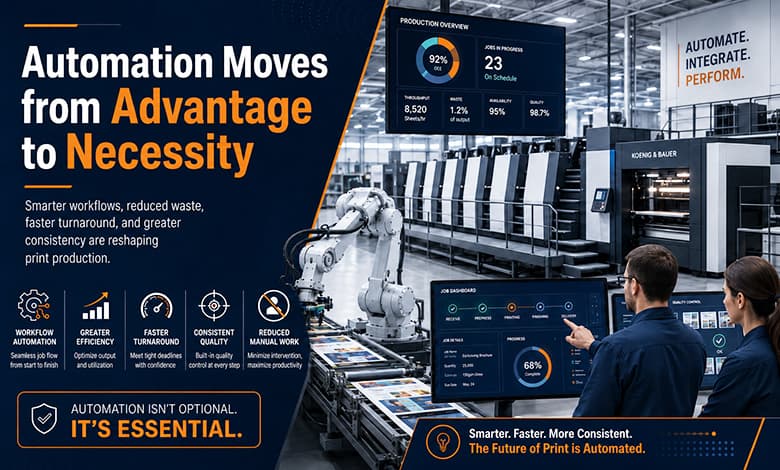
Automation is becoming essential for survival. It is no longer only a competitive advantage for large companies. Even medium-sized printers need better workflow control to reduce errors, waste, delays, and unnecessary labour costs.
Automation can support estimating, job submission, prepress, colour management, production scheduling, inventory control, finishing, invoicing, and customer communication. Management Information Systems, web-to-print platforms, automated preflight tools, and digital workflow solutions can help printers operate more efficiently.
In the Middle East, automation is especially important because skilled labour can be difficult to retain, and manual workflows often create bottlenecks. A job may pass through sales, design, prepress, production, finishing, delivery, and accounts. If each stage depends on manual communication, errors become more likely.
Printers that invest in automation can improve turnaround time, reduce rework, and protect margins. Those that continue to operate with disconnected systems may find it harder to compete.
Suppliers, OEMs, and Distributors Under Pressure
Printers are not the only ones facing cost pressure. OEMs, distributors, paper merchants, ink suppliers, consumables providers, and spare parts suppliers are also dealing with higher costs and supply chain uncertainty.
For Middle East printers, this makes supplier reliability more important than ever. The lowest price is not always the best option if the supplier cannot guarantee availability, service, or technical support. A delayed spare part or unavailable consumable can stop production and cause losses far greater than the initial saving.
Regional distributors now play a critical role. They must maintain stock, provide fast technical support, train operators, and help customers improve productivity. OEMs that invest in local service networks and regional support will have an advantage.
For printers, supplier selection should be based on long-term value. Availability, support, training, parts, response time, and trust are becoming just as important as purchase price.
Moving the Conversation from Price to Value
One of the biggest challenges for printers is changing how customers see print. When print is treated as a commodity, buyers focus mainly on price. But when print is linked to business results, the conversation changes.
A luxury carton can improve product perception. A well-produced catalogue can strengthen a brand. A personalised direct mail campaign can increase response. A high-quality label can build trust on the shelf. Exhibition graphics can attract visitors and support sales conversations. In each case, print has value beyond its production cost.
Middle East printers need to become better at selling this value. They should show customers how better design, better materials, finishing, personalisation, security features, sustainability, and integration with digital campaigns can improve results.
This is especially important as budgets become tighter. Customers will still spend on print, but they will expect it to deliver stronger impact.

Practical Steps for Regional Print Businesses
To manage this new reality, Middle East print businesses should focus on several practical actions.
They should review pricing more frequently and avoid locking themselves into long-term fixed rates without protection. They should monitor material costs closely and improve communication between sales, purchasing, and production teams. They should reduce waste, improve workflow efficiency, and invest in automation where it delivers measurable savings.
They should also move toward higher-value applications such as premium packaging, labels, personalised print, short-run digital production, embellishment, security printing, sustainable materials, and integrated print-digital campaigns.
Just as importantly, printers should educate their customers. Many buyers do not fully understand how global supply chains, imported materials, finishing requirements, and production complexity affect price. A more informed customer is more likely to appreciate the value of reliable, high-quality print.
What This Means for the Future of Print in the Middle East
Higher costs are unlikely to disappear soon. Geopolitical uncertainty, shipping disruption, imported material dependency, labour pressure, energy volatility, and changing customer expectations will continue to shape the Middle East print market.
But this is not only bad news. Cost pressure is also pushing the industry to become more efficient, more automated, more specialised, and more value-driven. Printers that simply absorb higher costs will struggle. Printers that manage costs intelligently, communicate clearly with customers, and focus on high-value print will be better positioned for the future.
For the Middle East printing industry, the message is clear: the era of cheap, volume-driven print is giving way to a more strategic market. Print still matters, but it must now prove its value more clearly than ever.