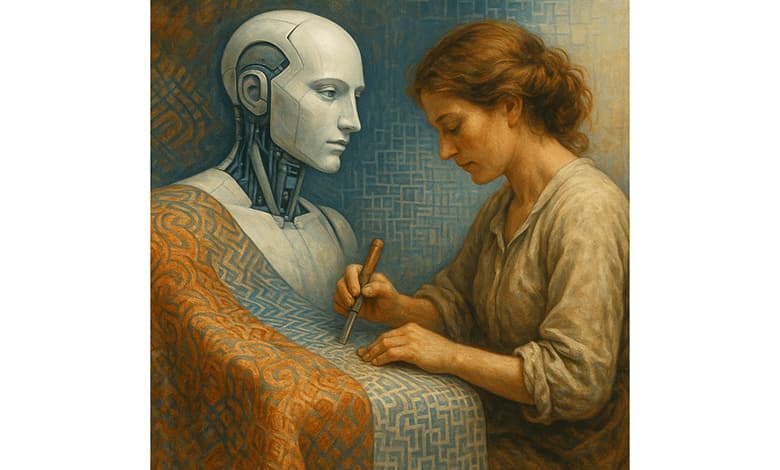
The history of design has always been defined by a delicate balance between hand and tool, mistake and masterpiece, fleeting and timeless. Today, that balance faces a new challenger: artificial intelligence. As algorithms grow more sophisticated, capable of producing images and patterns with dizzying speed and flawless precision, a question emerges: are we approaching the end of human creativity, or the beginning of a new renaissance?
History reminds us that innovation rarely erases artistry; it reshapes it. When the loom disrupted weaving, when the camera arrived to challenge painting, when the printing press was accused of cheapening knowledge—each moment of upheaval ultimately gave rise to new forms of beauty and expression. Machines took on repetition and precision, but the human impulse to create only deepened, finding new ways to express soul, imperfection, and meaning. AI is simply the newest chapter in that long story.
Perfection, once admired, has become inexpensive. An algorithm can generate flawless symmetry, seamless patterns, and infinite variations at the push of a button. But what it cannot replicate is resonance. It cannot tell us why one shape makes us nostalgic, why a crooked line feels alive, or why a flawed object often feels more precious than one without blemish. The true luxury of the future may not lie in immaculate surfaces, but in irregularities—the brushstroke that wavers, the dye that bleeds, the stitch that carries a story.
This shift places designers in a position of strength. Instead of fearing replacement, they can embrace AI as a collaborator—a tireless apprentice that handles the repetition while leaving judgment and storytelling to the human mind. The emerging role is not just craftsman, but what might be called craftsmind: a creator who uses the machine as tool and canvas, yet reserves for themselves the higher act of imbuing meaning.
AI also broadens our creative lens. Nature, a timeless source of inspiration, can now be translated through data. The mathematics of tides, the algorithms of coral growth, or the branching of trees can become design languages—patterns that feel both deeply organic and newly reimagined. At the same time, a renewed sense of play may become a radical act. Bold colors, exaggerated proportions, whimsical details—these gestures cut through the logic of code to remind us that creativity is not only about efficiency, but also about delight.
The machine may be able to generate an image, but only humans can give it soul. Meaning emerges from heritage, rituals, and lived experience—the invisible weight of memory and culture embedded in every design. As the boundaries blur between hand and machine, perhaps the future of design is neither purely human nor purely digital, but a fusion of both: a form of soulful precision, where glitches and irregularities are not flaws to be corrected but marks of authenticity.
What lies ahead is not the decline of craft, but its transformation. The future belongs to those who welcome the machine while refusing to surrender the story. Technology may replicate perfection, but only we can make it human.