The printing and packaging industry across the Middle East is entering one of the most challenging periods in its modern history, as escalating tensions in the Gulf ripple through supply chains, production economics, and end-market demand. What was already a cost-sensitive, highly competitive sector is now being reshaped by geopolitical disruption, forcing print houses and converters to rethink not only their operations, but their long-term strategies.
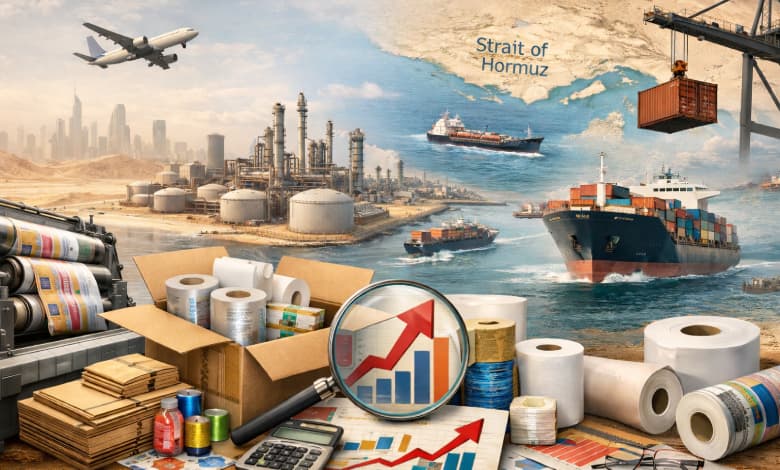
At the center of the disruption lies the region’s deep structural dependence on petrochemicals. Printing inks, flexible films, laminates, coatings, and a wide range of substrates are directly or indirectly tied to oil derivatives, making the industry particularly vulnerable to volatility in energy markets. With shipping routes through the Strait of Hormuz under pressure and freight insurance premiums rising sharply, the cost of moving raw materials has surged. The knock-on effect is being felt across the entire value chain.
The Middle East accounts for over 40% of global polyethylene exports. Conflict-driven supply tightening and rising oil prices have increased packaging costs by more than 20% in certain categories. Every $10 per barrel increase in oil prices adds several cents per pound to plastic packaging production costs. Logistics disruptions have caused ‘just-in-time’ supply chains to fail, leading to inventory shortages and shipping delays.
According to recent reporting by Reuters, the International Monetary Fund has downgraded economic growth expectations for the Middle East to around 1.1% in 2026, reflecting the broader slowdown triggered by the conflict. This macroeconomic pressure is translating directly into reduced industrial output and tighter margins for manufacturers, including print and packaging companies.
Industry voices are already quantifying the impact in stark terms. A report cited by The Times of India notes that printing-related production costs linked to the West Asia conflict have risen by as much as 30–40%. While this data originates outside the region, it reflects supply chain realities that are equally applicable to Middle Eastern converters, many of whom rely on the same global material flows and pricing structures. For smaller and mid-sized print houses, such increases are not easily absorbed, leading to difficult decisions around pricing, volumes, and customer retention.
At the same time, the demand side of the equation is weakening. The Middle East has long been a stronghold for premium packaging, supported by robust retail, luxury goods, and travel sectors. However, recent data reported by Reuters indicates a sharp decline in retail activity, particularly in key hubs such as Dubai, where luxury sales and mall traffic have dropped significantly. Mall sales fell by as much as 50%. This has an immediate impact on high-value printed materials, including folding cartons, specialty labels, and decorative packaging.
Travel retail, another critical segment, has also been hit hard. Airport disruptions and reduced passenger traffic are undermining demand for duty-free packaging and promotional print materials. As one industry observer noted in a Reuters report, the conflict has “taken a toll on airport shopping,” highlighting how quickly geopolitical instability can cascade into reduced print volumes across multiple sectors.
Beyond economics and demand, logistics has emerged as one of the most critical pain points. The Persian Gulf is not just an energy corridor but a vital artery for global trade, and disruptions have led to delays, rerouting, and in some cases, stranded shipments. For print houses operating on tight production schedules, even minor delays in receiving substrates such as paperboard, films, or aluminum can halt operations. The result is a growing tendency among converters to increase inventory buffers, despite the financial strain this imposes.
Yet within this challenging environment, a notable structural shift is beginning to take shape. Reliance on Middle Eastern feedstock to the tune of $20-$25 billion, passing through the Strait of Hormuz each year, has led to widespread plastic shortages. Supply of polyethylene and polypropylene—core for flexible packaging and caps—is severely constrained, as the region represents 25% of global exports for these materials. Additionally, virgin plastic prices have hit 4-year highs. Shortages and rising costs of plastic-based materials are accelerating interest in paper and fiber-based alternatives.
According to Reuters, some packaging producers have reported a significant surge in demand for paper solutions as plastic supply tightens. Inquiries for paper-based packaging tripled at some firms as buyers sought alternatives to plastic. This trend aligns with broader sustainability goals already gaining traction in the region, but the current crisis is acting as a powerful catalyst, compressing years of gradual transition into a much shorter timeframe. The paper and fiber-based packaging market is projected to reach $449.92 billion by 2030, with growth accelerating as brands eliminate plastic to mitigate supply risks.
For many print houses, this shift represents both a challenge and an opportunity. While transitioning to new substrates requires investment, process adjustments, and sometimes new equipment, it also opens the door to new business models and markets. Converters that can adapt quickly—offering sustainable alternatives without compromising quality or performance—are likely to emerge stronger once the current turbulence subsides.
The response from industry players has been pragmatic rather than optimistic. Conversations across the sector suggest a focus on survival and resilience rather than growth. Companies are renegotiating supply contracts, exploring alternative sourcing strategies, and reassessing pricing models. In some cases, long-standing customer relationships are being tested as printers attempt to pass on a portion of the increased costs, while still remaining competitive in a market that is itself under financial pressure.
What makes the current situation particularly significant is that it is not merely cyclical. The combination of geopolitical risk, supply chain fragility, and shifting material preferences is driving a deeper structural transformation. The Middle East’s historical advantage as a low-cost, petrochemicals integrated production hub is being challenged, prompting a gradual diversification of supply chains and a rebalancing of global sourcing strategies.
Looking ahead, the trajectory of the industry will depend heavily on the duration and intensity of the conflict. A de-escalation could stabilize markets and restore some degree of normalcy, but the lessons of the past months are unlikely to be forgotten. Print houses and packaging converters are now more acutely aware of their exposure to external shocks, and many are expected to continue investing in flexibility, efficiency, and sustainability.
In this sense, the current crisis may ultimately serve as a turning point. While the immediate impact has been disruptive and, in many cases, damaging, it is also forcing the industry to evolve. For the Middle East’s printing and packaging sector, the path forward will not be defined by a return to the old normal, but by the ability to adapt to a new and more uncertain reality.