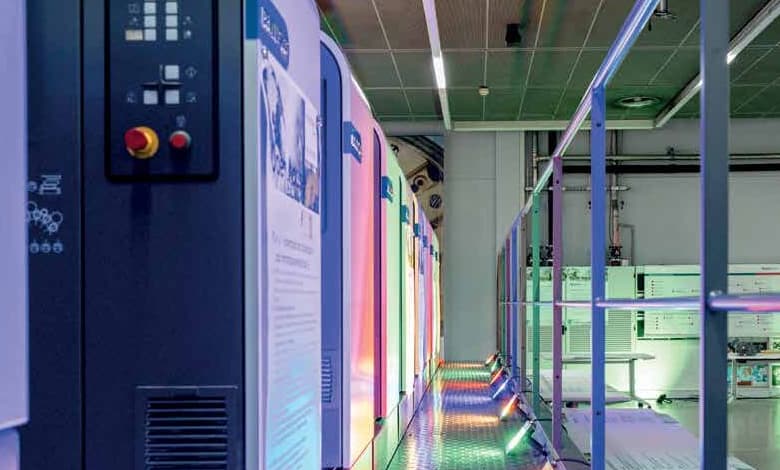
The announced closure of Manroland Sheetfed’s Offenbach operations is more than a company failure. It is a symbolic moment for German engineering, the global printing machinery industry, and the future structure of offset printing. According to the news, the Offenbach factory will close permanently on 1 June 2026, after protective insolvency proceedings, failed investor talks, a sharp fall in Chinese demand, €43.2 million in 2025 losses, and the expected loss of around 748 jobs.
A German industrial warning sign
Manroland’s collapse comes at a bad moment for Germany. The country’s manufacturing model is under pressure from high energy costs, weaker export demand, geopolitical uncertainty, tariffs, and competition from Asia. Recent German data points to renewed industrial weakness: Reuters reported that German private-sector activity contracted in April 2026, while business sentiment fell sharply amid war-related uncertainty and energy-price pressure.
This matters because companies like Manroland were built on the classic German formula: deep engineering, high labour skill, precision manufacturing, long production cycles, and export-driven demand. That formula works when global markets are stable and customers are investing in expensive capital equipment. It breaks down when printers delay investment, China weakens, financing becomes costly, and machine builders cannot spread R&D and factory costs across enough new press sales.
In that sense, Offenbach is not only a factory closure. It is evidence that even highly respected German machinery brands can become vulnerable when their market narrows too far.
The historical weight of Manroland
The tragedy is heavier because Manroland was not a marginal player. Its roots go back to Faber & Schleicher, founded in Offenbach in 1871, and the company built the first Roland sheetfed offset press in 1911. Manroland’s own history highlights milestones such as the Ultra four-colour sheetfed offset press at drupa 1951, the Roland 700 in 1990, the Roland 900 in 1995, DirectDrive technology in 2006, and the Roland 700 Evolution in 2014.
The name “Roland” itself became part of offset history. Offenbach was one of the places where lithographic heritage evolved into industrial offset technology. The city’s history notes that Faber & Schleicher and its successors were at the forefront of innovation, and that Roland machines reached print shops on every continent.
So the closure is not simply the disappearance of one production site. It is the end of one of the great homes of sheetfed offset engineering.
Is offset technology dying?
No. That would be the wrong conclusion.
What is dying is the old business model of selling large numbers of heavy mechanical presses into a broad commercial-print market. Offset itself remains highly relevant, especially in packaging, folding cartons, high-volume commercial work, labels, and security printing.
The future of offset is narrower but more sophisticated. It will be driven by:
• packaging rather than general commercial print;
• automation rather than manual craftsmanship alone;
• shorter makeready and lower waste;
• hybrid workflows combining offset, digital, coating, foiling, inspection, and finishing;
• data-driven production and predictive maintenance.
This is already visible in the strategies of surviving competitors. Koenig & Bauer’s drupa focus was end-to-end packaging workflows, digital solutions, automation, and Rapida sheetfed performance up to 22,000 sheets/hour. Heidelberg has also emphasized packaging growth and high-capacity sheetfed technology, including strong China Print 2025 sales in packaging and the expansion of VLF sheetfed offset for packaging.
Digital printing is growing, especially for short runs, personalization, labels, and flexible packaging. But digital has not replaced offset at industrial scale. Drupa’s own analysis notes that digital packaging adoption is increasing, but large-scale adoption by major brands remains slower than predicted.
So the future is not “digital versus offset.” The future is automated offset plus digital where digital makes economic sense.
Why Manroland failed despite strong technology
China once represented around 40% of Manroland Sheetfed’s revenue, and the collapse in that market badly damaged the company. Manroland’s own restructuring statement also identifies a sharply shrinking press market and China’s decline as major causes, while confirming the €43.2 million 2025 loss.
This suggests the problem was not simply technical inferiority. Manroland presses were respected. The problem was strategic and structural:
Manroland remained too dependent on a shrinking new-machine market, too exposed to China, and too burdened by the cost of maintaining a massive integrated German manufacturing complex. Its Offenbach site included headquarters, production halls, foundry, R&D, training, and print technology centre across roughly 114,000 m². That kind of industrial base is impressive, but it becomes dangerous when sales volume falls.
A factory like Offenbach needs throughput. Without enough new press orders, excellence itself becomes expensive.
Impact on Middle Eastern printers
For Middle Eastern printers, the closure has serious practical implications, especially for companies running Roland 700, Roland 900, and Roland 900 XXL presses.
The first concern is spare parts. If the service and parts business is sold and continues properly, the installed base can survive for years. The service and spares business may still attract buyers. But uncertainty will immediately affect confidence. Printers may start buying critical parts earlier, especially electronics, grippers, rollers, bearings, feeder/delivery components, control boards, and proprietary modules.
The second concern is machine resale value. Used Manroland presses in the Middle East may face a discount if buyers fear future service difficulties. This will not make the machines worthless, but it will shift negotiation power toward buyers.
The third concern is service dependency. Middle Eastern printers often depend on external technicians and imported parts. Any delay in the post-closure service structure could mean longer downtime, higher emergency repair costs, and more reliance on independent engineers.
The fourth concern is investment psychology. A packaging printer in Saudi Arabia, UAE, Iran, Egypt, Turkey, or Iraq considering a new B1 or VLF offset press will now be more likely to choose Heidelberg, Koenig & Bauer, Komori, RMGT, or Chinese alternatives, depending on budget and support availability. Even if Manroland’s technology remains strong, the fear of orphaned technology will hurt future sales.
What Middle Eastern printers should do now
Printers operating Manroland equipment should act calmly but quickly.
They should audit their installed machines, identify critical wear and electronic components, secure a one-to-two-year spare-parts buffer, and confirm who will legally handle service obligations after the closure. They should also document software versions, electrical schematics, maintenance records, and local technician contacts.
For new investments, the advice is blunt: buying a new Manroland press now would be risky unless the service/spares continuity is contractually guaranteed by a credible buyer. For used equipment, the machine may still be attractive if the price is low enough and the buyer has strong technical capability.
The demise of one historic manufacturing model
The closure of Manroland Sheetfed’s Offenbach factory is not the death of offset printing. It is the death of one historic manufacturing model.
Offset will survive where it is productive, automated, packaging-focused, and integrated into smart workflows. But the market no longer has room for every traditional European press manufacturer to maintain large, expensive factories while depending on cyclical export demand.
For the Middle East, the lesson is practical: Manroland presses remain capable machines, but ownership risk has increased. Printers should protect themselves through spare-parts planning, service agreements, and careful investment strategy.
The deeper meaning is this: German offset engineering is not finished, but its golden age of broad industrial dominance is over. The future belongs to fewer manufacturers, smarter factories, packaging-led demand, and printers who treat technology not as prestige, but as a controlled business risk.