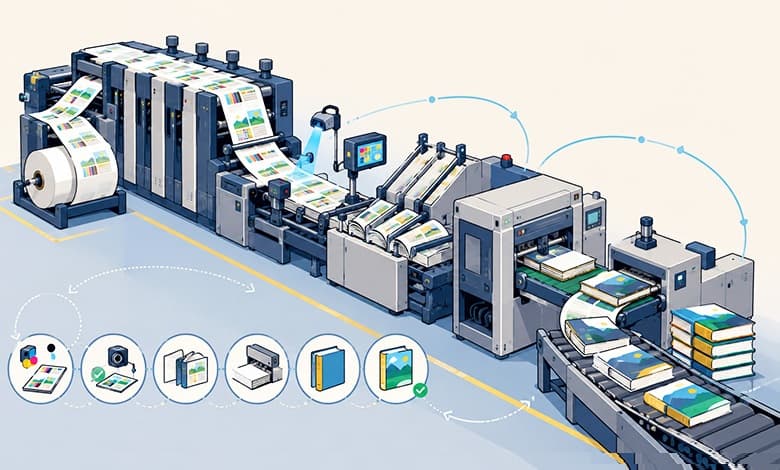
Why workflow, inspection, web handling, folding, binding and trimming machinery must be evaluated together with the digital press.
For years, digital print quality has been judged mainly by resolution, colour, ink performance, substrate compatibility and press speed. Yet a printed roll or sheet can leave the press looking excellent and still become unacceptable through poor folding, inaccurate trimming, weak binding, incorrect page order or mismatched personalised content.
The real test is the completed book, catalogue, manual, mailing piece or personalised publication. In high-speed inkjet and short-run production, finishing must therefore be treated as part of the quality system rather than as a separate department.
Finishing Is Part of Quality Assurance
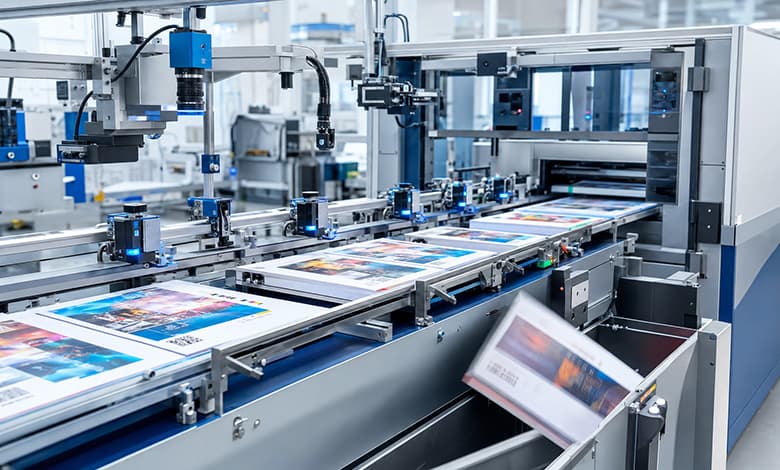
Modern lines use production data, cameras, sensors and servo-controlled equipment to protect the printed image through every conversion stage. Barcodes or 2D data-matrix codes printed in the margins can identify the job, page sequence, format, cover and binding instructions. Inspection cameras verify content, registration, orientation and product identity. A faulty item can then be rejected or diverted for reprinting instead of contaminating the batch.
The workflow layer is equally important. Systems such as Müller Martini Connex can connect production equipment with MIS or MES planning through JDF data and collect operating information from both Müller Martini and third-party machines. Operators can see stoppages, waste, output and recurring errors across the line rather than judging each machine separately.
What an Integrated Finishing Line Requires
For roll-fed inkjet production, the line normally begins with an unwinder and web-handling modules for tension, alignment and buffering. These are followed by inspection, slitting, perforating or creasing, cross-cutting, folding and stacking equipment. Hunkeler’s Generation 8 portfolio illustrates this structure: the UW8 unwinder feeds the web, the WI8 inspection system checks print and data quality, and modules such as the CS8 cutter, WF8 web folder and LS8 stacker convert the roll into sheets, folded products or stacks. Reliable web control is essential because stretching or lateral movement can shift folds, perforations and trim positions away from the printed image.
Tecnau’s Revolution 50 AutoSetup is another example for automated roll-to-cut-and-stack production. It can change page length and imposition automatically, move between one-up and four-up configurations, and use 2D codes to trigger job changes. This type of system suits book blocks, direct mail, leaflets and other short-run applications where consecutive jobs may have different formats.
Cut-sheet digital printers need a different configuration. A B2 sheet-processing system such as Horizon’s SmartStacker can slit, cut, collate and stack printed sheets into book blocks. It can be connected to a BQ-500 perfect binder and an HT-1000V variable three-knife trimmer. For stitched catalogues, manuals and booklets, a saddle-stitching line such as the Horizon iCE StitchLiner Mark V can gather, stitch and trim digitally printed sections.
Binding and Trimming Complete the Product
The binder must match the application. Perfect binders use hotmelt or PUR adhesive for softcover books, while saddle stitchers suit thinner booklets and catalogues. Thread sewing or case-binding equipment may be required for premium publications. The important point is automatic adjustment: clamp width, spine preparation, glue application, cover scoring and nipping pressure should change according to the digital job data.
For highly variable book-of-one production, Tecnau’s Libra 800 combines book-block preparation, variable binding and automated three-knife trimming. It can change book dimensions, thickness and cover type from one product to the next, using a barcode to set the trimmer without manual adjustment.
Trimming deserves particular attention because uneven edges, damaged corners and off-centre margins are immediately visible. A programmable guillotine may be sufficient for grouped short runs, but book-of-one production benefits from barcode-controlled three-knife trimmers that adjust for every book.
The Finished Product Is the Final Proof
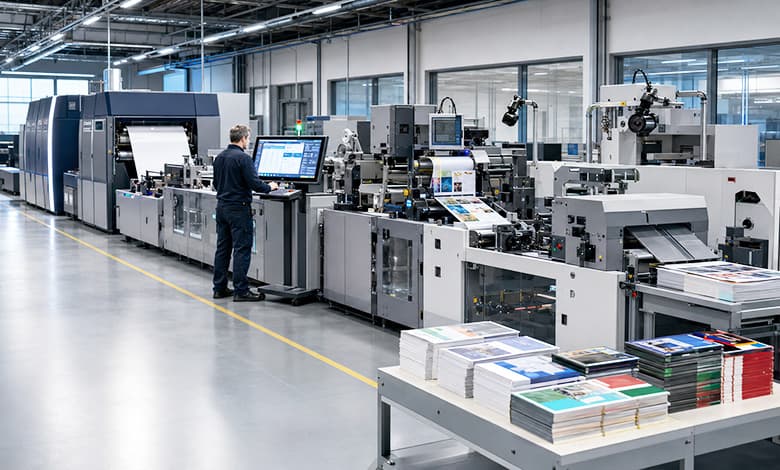
Printers should evaluate the press and finishing line as one manufacturing system. The required investment may include workflow software, inspection cameras, unwinders, web guides, slitters, perforators, folders, cutters, stackers, binders, stitchers and variable trimmers. Not every printer needs every module; the correct configuration depends on whether the main products are books, direct mail, catalogues, manuals or commercial sheets.
Automation does not remove the operator. It shifts the role from repeated mechanical setup to workflow supervision, exception handling, material control and quality analysis. The press creates the image, but only a connected and correctly specified finishing line turns it into a reliable professional product.
Editorial note: Product names are representative examples of available finishing technology and do not imply endorsement.