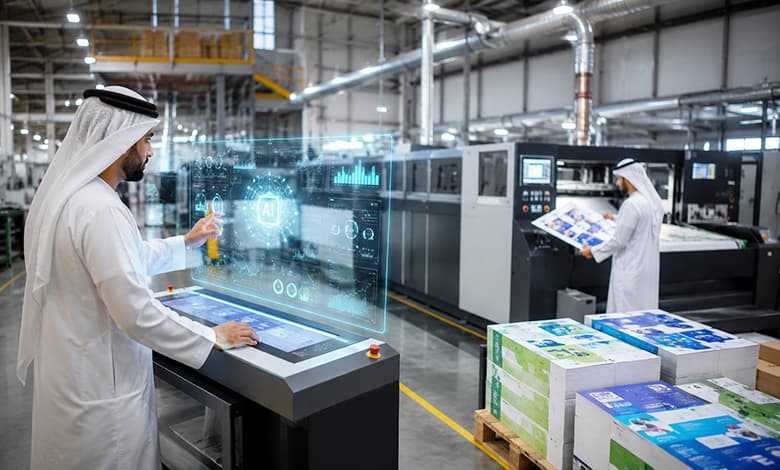
In a region shaped by multilingual production, tight deadlines, imported materials, demanding brand owners, and rapid economic development, artificial intelligence offers printers something more valuable than simple automation: the ability to make better decisions at greater speed.
Artificial intelligence is frequently promoted as a way to reduce workloads, cut staffing requirements, and complete everyday tasks with minimal effort. For printing companies across the Middle East, that promise is understandably attractive. The regional industry operates under constant pressure from short delivery schedules, fluctuating material costs, skilled-labour shortages, complex customer requirements, and intense competition.
Commercial printers, packaging converters, label producers, sign makers, and digital print specialists are expected to respond quickly while maintaining quality and controlling costs. Customers often require several language versions, multiple product variations, customised quantities, premium finishing, and delivery across different markets.
In this environment, any technology that can accelerate estimating, artwork checking, customer communication, scheduling, or production planning deserves attention. Yet companies introducing AI may notice something unexpected: employees are not necessarily becoming less busy. They may be preparing more quotations, reviewing more jobs, communicating with customers more frequently, and becoming involved in tasks that previously required specialist support.
This does not mean AI has failed. It means the nature of work is changing. For Middle East printing companies, the greatest opportunity is not to remove work from the business. It is to shift people away from repetitive administration and towards the decisions, conversations, and improvements that strengthen margins and customer relationships.


The Middle East Market Rewards Speed—but Speed Alone Is Not Enough
Speed has always been important in the regional printing market. Product launches, exhibitions, retail promotions, hospitality campaigns, government events, religious seasons, real estate developments, and major sporting or entertainment programmes can all generate urgent demand. A customer may require thousands of brochures, signs, cartons, labels, menus, promotional displays, or personalised items within an extremely short timeframe.
AI can help printers respond faster. It can summarise enquiries, identify missing specifications, generate initial job tickets, retrieve historical production data, and support scheduling decisions. But completing the same tasks faster does not automatically create a stronger company. A printer can produce more quotations without improving the percentage of business won. A customer service team can answer more messages without increasing customer loyalty. A prepress department can check more files without reducing press stoppages. The real value appears when faster routine work creates more time for higher-value activity.
Smarter Estimating in a Volatile Cost Environment
Estimating is one of the clearest areas where AI can support Middle East printers. Preparing an accurate quotation requires detailed knowledge of paper, board, film, ink, plates, consumables, machine speeds, makeready, wastage, finishing, outsourcing, logistics, and payment terms. In many regional markets, materials and equipment are imported. Prices can therefore be affected by freight charges, supplier availability, exchange rates, lead times, and minimum-order requirements.
A quotation based on outdated information can quickly become unprofitable. AI-assisted estimating systems can help gather job specifications, compare similar historical orders, calculate production options, and identify missing information before a price is submitted. However, the estimator remains essential. An AI system may calculate that one production route is technically cheaper, but an experienced estimator understands the realities behind the numbers.

Is the required substrate currently available?
Will it arrive before the customer’s deadline?
Does the finishing supplier have capacity?
Would a digital process be more economical for the first quantity, with offset or flexographic production used for a larger repeat order?
Could the job be redesigned to reduce waste?
Does the price reflect the commercial risk of delayed approval or long payment terms?
These questions are particularly important in a market where printers may face sudden changes in material availability and customers may expect quotations almost immediately. AI can accelerate the calculation. Human experience must still protect the margin.
Multilingual Production Creates a Strong Use Case
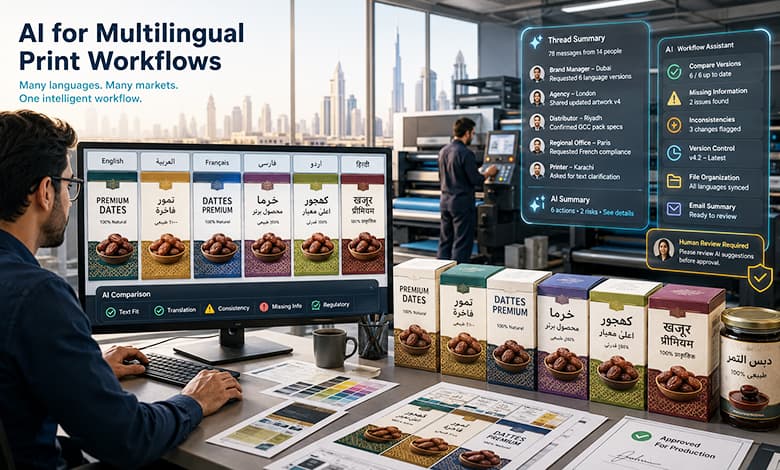
The Middle East is one of the world’s most linguistically diverse business environments. A single job may require Arabic and English, with additional versions in French, Farsi, Urdu, Hindi, or other languages depending on the market and audience. Packaging for regional distribution may require several sets of regulatory information. Retail campaigns may need separate versions for different Gulf countries. Hospitality and tourism customers may request multiple language editions at short notice. This creates a heavy prepress and approval burden.
AI can assist by comparing language versions, checking whether key information is missing, identifying inconsistencies between files, and helping teams organise multiple artwork variations. It can also help customer service and production teams summarise long email chains involving brand owners, agencies, distributors, and regional offices. However, automated language support must be treated carefully.
An AI system may identify a wording difference, but it may not understand whether that difference is legally required, culturally appropriate, or commercially significant. Arabic typography, right-to-left layouts, bilingual hierarchy, number formats, ingredient declarations, and country-specific requirements still need knowledgeable human review. The best application is therefore not to remove language specialists or experienced prepress employees. It is to help them identify potential issues earlier and focus their attention where it matters most.
Turning Customer Service into Account Development
In many Middle East printing companies, customer relationships remain highly personal. Customers frequently communicate through a mixture of email, telephone calls, messaging applications, face-to-face meetings, and informal approvals. Job information can become scattered across several channels.
Customer service representatives may spend much of the day searching for the latest artwork, confirming approvals, checking production status, resending proofs, or asking departments for delivery updates. AI-connected systems can help consolidate this information. They can prepare routine responses, summarise customer conversations, retrieve job status, flag missing approvals, and remind teams about promised delivery dates. This can improve response times, but the larger opportunity is commercial.
When customer service employees spend less time chasing information, they can devote more attention to understanding customer plans.
Is a food producer preparing a new product range?
Does a retailer need materials for Ramadan, Eid, back-to-school, or National Day campaigns?
Is a hotel group opening a new property?
Does a cosmetics brand require short-run packaging for several product variants?
Could a customer reduce costs by standardising formats or consolidating orders?
Would premium embellishment increase the perceived value of the final product?
In this model, customer service becomes more than an administrative department. It becomes an early-warning system for new business and a source of practical advice for customers.

AI Can Strengthen Prepress and Quality Control
Prepress remains one of the most critical stages in the printing process. An artwork error discovered before production may take minutes to correct. The same error discovered after printing, laminating, die-cutting, binding, or installation can become extremely expensive. AI-assisted preflight tools can help identify missing fonts, incorrect colour spaces, low-resolution images, transparency problems, bleed issues, dieline inconsistencies, and differences between approved and production files.
This is especially useful in regional operations handling high volumes of last-minute artwork and multiple versions. But automated checking cannot fully replace technical judgment. A system may confirm that an image meets a minimum resolution. An experienced technician determines whether it will reproduce well at the required size and on the selected substrate. A system may detect a colour-profile mismatch. A colour specialist understands how the artwork will behave on a particular press, film, paper, board, or ink set.
A system may approve a technically correct dieline. A packaging professional may notice that the structure will create difficulties during filling, transport, or retail display. AI should therefore remove routine inspection from the workload while preserving human attention for complex and high-risk jobs.
Helping Less-Experienced Employees Perform at a Higher Level
The regional print industry continues to face a shortage of experienced technical personnel. Senior estimators, colour specialists, press operators, production planners, and workflow experts are difficult to replace. At the same time, younger employees entering the industry need time to develop practical knowledge. AI can help reduce this gap.
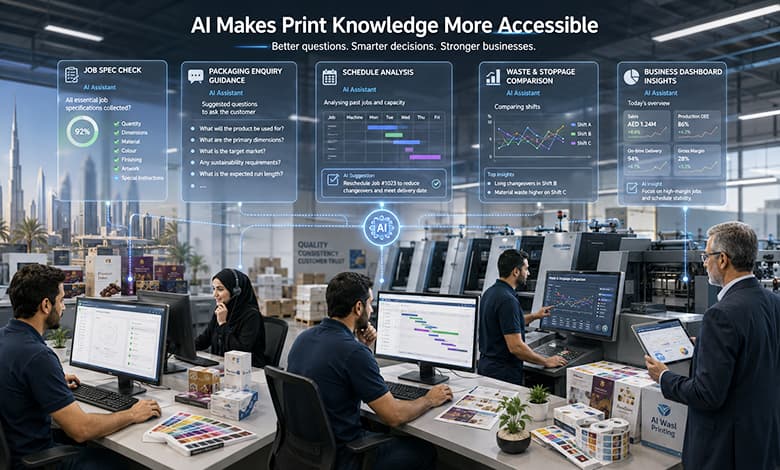
A junior estimator may use an AI assistant to review whether all essential job specifications have been collected. A customer service employee may receive guidance on the technical questions required for a packaging enquiry. A production planner may analyse previous jobs before selecting a schedule. A press operator may compare waste and stoppage patterns across several shifts. A manager may create a basic dashboard combining information from production, sales, and the management information system without commissioning a major software project. AI does not instantly create expertise. It can, however, make knowledge more accessible and help employees ask better questions. This may be especially valuable for small and medium-sized printing companies that cannot maintain large IT, data-analysis, and process-engineering teams.
Connecting Disconnected Systems
Many printing operations in the Middle East have invested in advanced machinery but still rely on fragmented information flows. A modern press may generate detailed production data, while estimating is handled in a separate system. Customer communication may sit in email and messaging applications. Delivery information may be managed through spreadsheets. Maintenance records may remain on paper. AI can help interpret and connect information from these different sources.
A production manager could receive an alert when repeated delays are linked to a particular substrate, finishing process, or type of artwork. Management could compare quoted margins with actual production performance. Sales teams could identify customers whose order frequency has declined. Maintenance teams could review recurring machine faults and prepare preventive actions. The technology does not remove the need for clean data or proper system integration. It does, however, make previously inaccessible information easier to analyse and use. For regional printers that have collected years of job and production data without fully exploiting it, this may become one of AI’s most valuable applications.
The Risk of More Work Without More Value
There is also a danger. When AI allows estimators to produce quotations more quickly, management may simply demand more quotations. When customer service representatives handle enquiries faster, they may be given more accounts. When prepress becomes more efficient, the company may accept more poorly prepared artwork without improving customer education. When managers gain access to more data, employees may be asked to prepare more reports and attend more meetings. The result is a business that produces more activity but not necessarily more profit.
Employees may constantly move between AI-generated drafts, alerts, customer messages, job updates, and production problems. They may feel productive while becoming increasingly overloaded. This risk is particularly relevant in a market where customers already expect immediate responses and urgent service. AI can unintentionally reinforce the idea that every enquiry, draft, or request must be handled at once. Printers therefore need to decide where speed creates value and where it simply creates pressure.
Human Relationships Still Matter
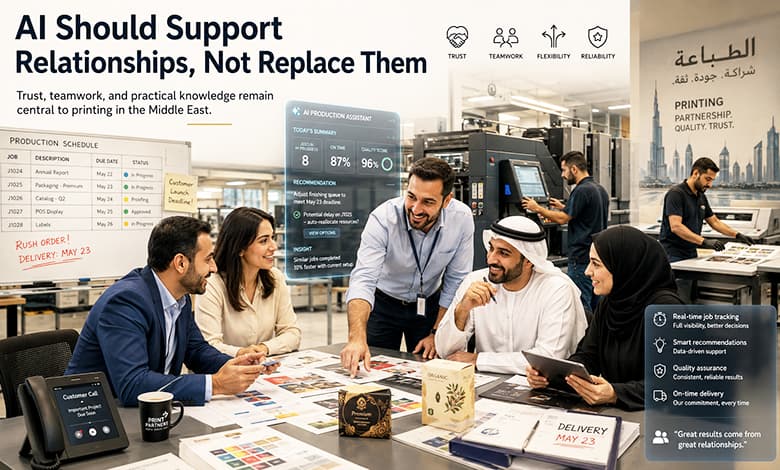
Printing remains a relationship-driven industry throughout the Middle East. Customers value reliability, trust, flexibility, and the confidence that a supplier will solve problems when deadlines become difficult. An AI-generated production summary cannot fully replace a conversation between sales, estimating, prepress, production, and finishing. An automated customer response cannot replace personal contact when a major delivery is at risk. A dashboard cannot replace the knowledge exchanged during a production meeting or a press-side discussion. These human interactions help companies understand customer priorities, identify recurring problems, and transfer practical knowledge between departments. AI should support these relationships, not remove them.
Building a Practical AI Strategy
Middle East printers do not need to introduce AI across the entire company at once. A better starting point is to select one workflow where repetitive work is causing delays or consuming skilled employees’ time.
This could be:
- preparing quotations;
- checking artwork;
- managing multiple language versions;
- responding to customer status enquiries;
- analysing production waste;
- creating job summaries;
- reviewing maintenance records;
- or identifying repeat-order opportunities.
The company should then define what success means beyond speed.
If estimating becomes faster, should the business improve quotation accuracy or win rate?
If customer communication becomes more efficient, should account teams increase proactive customer contact?
If artwork checking becomes more automated, should the company reduce remakes and press stoppages?
If production data becomes easier to analyse, should the company lower waste or improve machine utilisation?
These outcomes should be reviewed after a defined period.
Has AI improved margins?
Has it reduced avoidable errors?
Are customers receiving better service?
Are employees developing stronger capabilities?
Or has the company simply pushed more work through the same people?
From Automation to Competitive Advantage
Artificial intelligence will not remove the complexity of printing in the Middle East. Customers will continue to demand shorter runs, faster turnarounds, multiple versions, premium quality, and competitive prices. Material costs and availability will continue to change. Files will still arrive late. Approvals will still be delayed. Machines will still require skilled operators and proper maintenance. But AI can change how companies respond to these pressures.
It can reduce repetitive searching, checking, calculation, and administration. It can help employees access technical and commercial information more quickly. It can give less-experienced staff better support and allow specialists to focus on more valuable decisions. The regional printing companies that gain the most from AI will not simply be those that produce the same work faster. They will be the companies that use it to price more intelligently, manage multilingual complexity, improve production visibility, strengthen customer relationships, protect margins, and develop stronger teams. The objective is not to make printing companies less busy. It is to ensure that the work they are doing creates greater value.