Why Adhesives Matter
Every label owes its performance to one invisible hero: the adhesive. Without it, a label would never stay in place. But what exactly makes an adhesive effective, why can it sometimes fail, and how do we make sure it works reliably even in harsh conditions?
What Adhesives Are Expected to Do
Adhesives are designed to perform under very different demands. Some must stay put under ice-cold storage or direct contact with water, others need to remain crystal-clear on transparent packaging, and many must satisfy safety rules for pharmaceuticals or food.
Not all adhesives are permanent. In fact, certain applications call for labels that peel off cleanly, can be reapplied, or allow packages to be opened and resealed. Each of these scenarios requires a different balance of adhesive chemistry.
Common performance profiles include:
- Strong initial grab (high tack)
- Long-lasting bonds (permanent)
- Bonds that weaken over time (semi-permanent)
- Easy-peel functionality (removable)
- Ability to move the label around (repositionable)
- Reseal after opening (reclosable)
Typical technical requirements include:
- Working at very low or very high temperatures
- Resistance to water, oil, or chemicals
- Compliance with BS 5609 seawater durability
- Suitability for direct or indirect food contact
- Transparency and non-whitening in wet conditions
- Tamper-evidence features
- Cost efficiency in use
The Main Families of PSA Technology
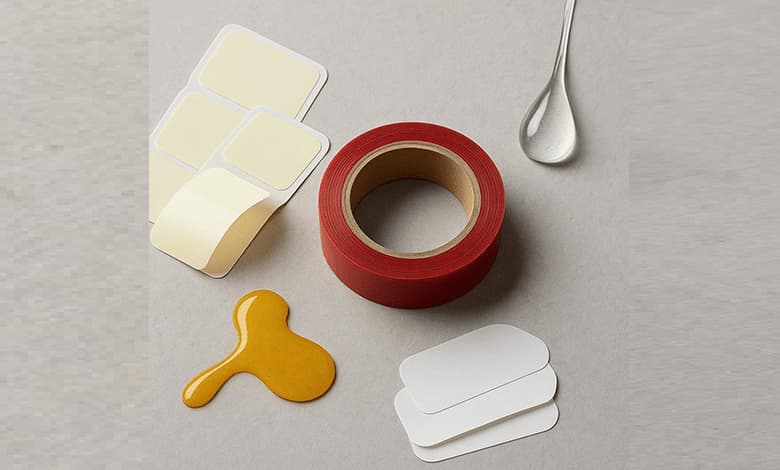
Pressure-sensitive adhesives (PSAs) are unique because they are always “ready to stick.” Unlike many glues, they don’t need heat, moisture, or chemical activation. They remain tacky above their glass transition temperature (Tg) and can bond with surfaces as diverse as paper, glass, plastic, and even metals.
The industry mainly relies on five approaches:
- Acrylic Solutions – Once dominant, solvent-based acrylics are now niche products, used mostly when extreme chemical resistance is needed.
- Rubber/Resin Systems – Less common today, but still valuable for peelable labels or products like oil-can labels.
- Hot-Melt Adhesives – A fast-growing category thanks to simple processing, strong tack, and reliable performance even in cold or wet conditions.
- Water-Based Acrylic Dispersions – The mainstream choice for most label producers, offering flexibility and more eco-friendly processing.
- Radiation-Cured Adhesives – Cured by UV or electron beam, these provide excellent heat resistance and are gaining ground in specialty applications.
What Makes a PSA Different?
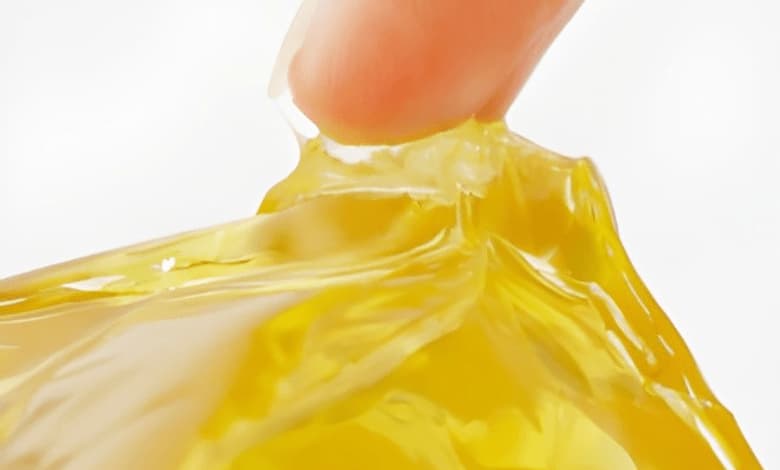
Think of a PSA as a material that behaves partly like a solid and partly like a liquid. It is soft and tacky, so it flows enough to wet the surface and form a bond, but it is also solid enough to hold that bond together.
This dual nature is called viscoelasticity, and it explains why PSAs can stick instantly, remain sticky even after peeling, and perform across different conditions.
Two key factors determine their performance:
- Tack – how quickly they grab a surface.
- Cohesion (shear strength) – how well the adhesive holds itself together under stress.
There is also the modulus, which describes how stiff or flexible the adhesive is, and it shifts with temperature. Too stiff and the adhesive becomes brittle; too soft and it loses holding power.
Balancing Chemistry and Processing
Designing PSAs is always a balancing act. Stronger cohesion usually comes with higher molecular weight, but that can also increase viscosity and make processing more difficult. Different chemistries solve this challenge in their own ways.
- Hotmelts soften and solidify reversibly — they “melt” when heated but regain pressure-sensitive properties when cooled.
- Acrylics form permanent cross-links during curing, so they maintain their properties even at high temperatures.
- UV-curable systems use light to create those bonds, offering stability in demanding applications.
Processing requirements also vary:
- Hotmelts are straightforward — melt, coat, cool.
- Acrylics (solution or emulsion) demand space, curing equipment, and expertise.
- UV systems rely on precise light sources for consistent curing.
Testing and Quality Control
To ensure adhesives perform as intended, industry standards like FINAT tests measure peel strength, tack, and shear. Additional tests simulate aging, environmental exposure, or application on small containers (mandrel tests).
These evaluations not only give numerical values but also reveal how and why an adhesive might fail — essential for applications where removability, safety, or durability is critical.
Sustainability Challenges
Modern adhesive development goes hand in hand with sustainability. Traditional PSAs can contaminate recycling streams, especially with PET bottles or paper. To address this:
- Some adhesives are designed to wash off in alkaline recycling baths, leaving plastics clean.
- Others form larger particles that can be screened out during paper recycling.
- Compostable and bio-based PSAs are beginning to reach the market as well.
Pressure-sensitive adhesives may look simple, but they are finely engineered materials balancing tack, cohesion, modulus, and processability. By choosing the right chemistry and formulation, labels can meet a wide range of performance demands — from freezer packs to high-heat environments — while also aligning with the growing push for sustainability.