Why successful commercial printers are rethinking how—and when—they transition beyond toner
By Ayman Aly , B2B Marketing Director, Canon Middle East
The transition questions every growing printer eventually faces
Growth is a sign of success—but it can also expose the limits of an existing production environment. As Colour volumes increase, turnaround expectations shorten and customers demand greater flexibility, many commercial printers reach a point where the question is no longer whether toner can produce the work, but whether it remains the most efficient way to do so.
Toner technology continues to play a vital role in commercial print and remains the right solution for many applications. However, as businesses evolve, so do the demands placed on production. Across the Middle East, printers are expected to deliver shorter runs, greater versioning and a broader range of applications while maintaining quality, consistency and profitability. The challenge is no longer simply deciding when to invest in new technology, it is recognizing when the business itself is ready for its next stage of growth.
“The question is no longer whether production inkjet is the future. The real question is when is your business ready to make that transition.”
The hidden cost of staying with toner too long
Production challenges do not necessarily mean existing equipment has reached its limits. More often, they signal that the business has evolved beyond the production model it was originally built around. The signs are familiar: growing colour volumes, tighter production schedules, increasing workflow complexity and greater operator intervention. As these pressures build, profitability depends less on press performance alone and more on workflow efficiency, automation, utilisation and production consistency.
At the same time, customers expect shorter runs, faster turnaround and greater application diversity. The challenge is no longer simply producing the work—it is producing it efficiently and profitably.
Why many businesses hesitate
Knowing when to move beyond toner is often more difficult than recognising the operational pressures.
For many commercial printers, the hesitation is not about technology, it is about timing. Is the business ready? Will future volumes justify the investment? Will additional productivity translate into sustainable growth, or simply create excess capacity?
The assumption that production inkjet requires an immediate leap to the highest-volume platforms often delays decision-making. Every business follows its own growth path. The most effective investment is rarely the largest, the one that aligns with current demand while creating room for future expansion.
Redefining the Transition to Production Inkjet
For many commercial printers, the transition beyond toner is not a single leap—it is a carefully timed business decision. As colour volumes grow and customer expectations continue to evolve, many businesses find themselves in a “middle ground” where toner economics no longer fully support their ambitions, yet the scale and investment of a high-volume production inkjet platform may still be more than the business requires.
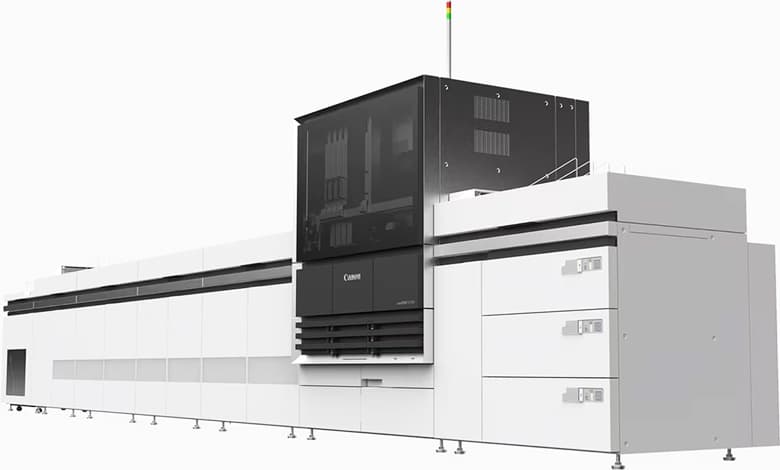
This changing market has highlighted the need for a more accessible pathway into production inkjet—one that enables businesses to increase productivity, improve operational efficiency and prepare for future growth without overinvesting in capacity. Recognizing this transition, Canon has expanded its sheetfed production inkjet portfolio with the varioPRINT iX1700, designed specifically to bridge the gap between established toner production and higher-volume inkjet environments.
However, a successful transition is about much more than introducing a new press. As commercial print operations become increasingly dynamic, business performance is shaped by workflow integration, automation, production consistency and the ability to move efficiently between different applications with minimal manual intervention. The most resilient print businesses are investing in complete production ecosystems where hardware, software and finishing work together to simplify operations, improve utilization and support long-term growth.
Ultimately, the strongest investment is not the one with the highest specification or greatest production capacity. It is the one that aligns with the business’s stage of growth, removes operational friction and creates the flexibility to expand into new applications and revenue opportunities with confidence.
Five questions every commercial printer should ask before investing
Before taking the next step beyond toner, every commercial printer should pause and ask five simple—but important—questions:
- Are customer requirements changing faster than our current production environment can comfortably support?
- Are we investing to solve today’s bottlenecks—or preparing for tomorrow’s opportunities?
- Will the next investment expand our application portfolio or simply increase production volume?
- How much of our production process could benefit from greater workflow automation and operational efficiency?
- Does this investment align with the business we want to become over the next five years?
There are no universal answers to these questions because every print business follows its own growth journey. What matters is asking them before making the next investment decision.
Building capability for the next stage of growth
The move into production inkjet is not about buying the biggest or fastest press. It is about recognising the right moment to invest in capabilities that support the next stage of business growth.
For today’s commercial printers, success is increasingly measured by the ability to respond faster, deliver a broader range of applications and adapt confidently as customer expectations continue to evolve. That is the thinking behind Power to Move—helping businesses make informed technology decisions that support sustainable, long-term growth.
Next in the Power to Move series: Where Offset and Digital Meet explores why B2 digital production is changing the relationship between offset and digital—not by replacing one with the other, but by helping commercial printers use both more strategically.